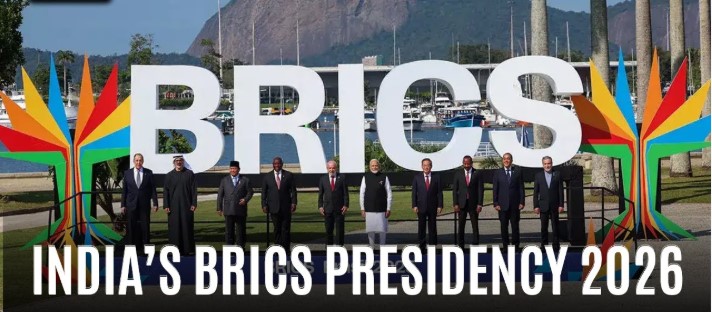
At the 18th BRICS Summit in New Delhi, PM Narendra Modi emphasized secure sea lanes, open supply routes, and seafarer safety during discussions with Russian President Vladimir Putin and Iranian President Masoud Pezeshkian. The leaders highlighted concerns over Western economic influence, US dollar dominance, sanctions, and global supply chain disruptions. BRICS, expanding to 21 members, aims to leverage economic strength for practical global solutions in trade, technology, and sustainable development.
New Delhi, September 12, 2026
Prime Minister Narendra Modi placed secure sea lanes, open supply routes and seafarer safety at the centre of India’s BRICS agenda as global leaders gathered in New Delhi for the 18th BRICS Summit. Modi also called for stronger trade, investment and technology partnerships among BRICS countries. He said their combined economic strength must now be turned into practical solutions for the world.
Russian President Vladimir Putin and Iranian President Masoud Pezeshkian, meanwhile, delivered pointed messages on Western economic influence and the dominance of the US dollar. Their remarks came at the BRICS Business Forum, held ahead of the two-day leaders’ summit.
The gathering is taking place amid the continuing US-Israel war on Iran, the conflict in Ukraine and growing pressure on global supply chains. Maritime trade and energy security have also emerged as major concerns.
Prime Minister Narendra Modi said global commerce could move forward only when vital trade routes remained open and safe. “Global trade can move forward only when sea lanes are secure, supply routes remain open and seafarers are safe,” he said. India remained a firm supporter of freedom of navigation and the safety of sailors, he added. The remarks carried particular importance for India. The conflict in West Asia has disrupted shipping and energy supplies. Attacks on vessels in the region have also claimed the lives of Indian crew members.
Prime Minister Narendra Modi referred to the changing size and influence of BRICS. He said the grouping had come a long way since its formation two decades ago. “Back in 2006, when this group was founded, it consisted of just four countries. Today, our BRICS and BRICS Partner family comprises 21 countries,” he said. BRICS began with Brazil, Russia, India and China. South Africa joined later, giving the grouping its present name. It has since expanded to include Egypt, Ethiopia, Iran, the United Arab Emirates, Saudi Arabia and Indonesia as full members. Several other countries have joined as BRICS partners. The wider grouping now represents different regions, political systems and stages of economic development.
Prime Minister Narendra Modi said BRICS countries accounted for 50 per cent of the world’s population, 40 per cent of global GDP and more than 25 per cent of international trade. The figures showed that BRICS was no longer a limited forum of a few emerging economies, he said. It had become an important platform with the capacity to influence global economic decisions.
The Prime Minister said India continued to grow despite instability and uncertainty in the world economy. The country, he said, had emerged as a source of confidence and stability. He also drew attention to rising barriers in international trade. At a time when countries were putting up economic walls, India was working to build bridges, he said. Prime Minister Narendra Modi presented India’s manufacturing and innovation approach through the message: “Make in India, Innovate with India, Scale for the World.” He invited BRICS countries and their businesses to work with India in manufacturing, innovation and new technology. India’s start-up ecosystem, skilled workforce and expanding consumer market could support wider partnerships, he said.
The Prime Minister also underlined the role of digital public infrastructure in inclusive growth. India’s experience with digital payments and technology-driven public services has drawn interest from several developing countries. He called for deeper cooperation in digital platforms, resilient supply chains, critical technologies and sustainable development. Stronger business links, he said, would help convert the political understanding among BRICS members into economic outcomes. “Let us turn BRICS’ ambition into action and collective strength into global solutions. Let BRICS move forward and take the world forward too,” he said.
Russian President Vladimir Putin said the global economy was undergoing deep structural changes. New centres of growth were emerging as the influence of older economic arrangements weakened. Putin said BRICS countries had large and dynamic domestic markets. Reliable business partnerships among them could provide greater stability during a period of global uncertainty. He criticised sanctions and unilateral trade restrictions imposed by Western countries. Such measures, he said, had disrupted transport systems, infrastructure links and established trade flows.
Putin called for stronger cooperation in investment, technology, payment systems and infrastructure. He also supported wider use of national currencies in trade among BRICS countries. At the same time, the Russian President said BRICS was not directed against any nation or group. “We are not against anyone. We are in favour of our interests,” he said.
Iranian President Masoud Pezeshkian gave a sharper message on the use of financial systems as a political tool. He said economic pressure was increasingly being used to block the legitimate trade of independent countries.
Pezeshkian called on BRICS to build mechanisms that would prevent one country from disrupting the lawful commerce of another. He sought greater use of national currencies and closer coordination among the financial systems of member countries.
The Iranian President also proposed a $10-billion BRICS joint reinsurance company to support large infrastructure and energy projects. Such an arrangement could reduce the risks created when insurance and financial services are affected by sanctions. He also called for digital customs systems, lower trade barriers and closer links among BRICS markets. The grouping, he said, should move from the exchange of raw materials towards integrated production and value chains.
The positions taken by Putin and Pezeshkian reflected concerns shared by countries facing Western sanctions. India’s emphasis remained on practical cooperation, stable supply chains and the protection of international trade routes.
Prime Minister Narendra Modi also held separate talks with Putin and Pezeshkian ahead of the summit. The discussions covered bilateral cooperation and the conflicts affecting Europe and West Asia. India again stressed dialogue and diplomacy as the way forward.
The New Delhi summit comes at an important stage in the evolution of BRICS. Its expansion has increased its economic and demographic weight. It has also brought together countries with different interests and foreign policy positions.
India’s task as chair is to keep the grouping focused on areas where common ground is possible. Trade, technology, development finance and secure supply routes offer that space. The discussions in New Delhi will determine how far BRICS can turn its growing global presence into practical cooperation.