India hosts the BRICS summit on September 12–13, with leaders including Putin, Xi, and Pezeshkian attending. Modi, as host, will lead discussions on economic reforms, energy security, and trade amid tensions in global supply chains and Ukraine conflict. Bilateral talks, especially between Modi-Xi, will focus on restoring bilateral ties post-2020 Galwan clash, covering border management and trade. BRICS' expanded membership reflects its evolving role in global governance, with discussions expected on UN reforms, local currency trade, and alternative financial systems while avoiding anti-West rhetoric. India’s theme emphasizes ‘resilience, innovation, and sustainability,’ positioning BRICS as a platform for the Global South.
New Delhi, September 11, 2026
India rolled out the diplomatic red carpet on Friday as world leaders began arriving in New Delhi for the 18th BRICS Summit. The main leaders’ sessions will be held at Bharat Mandapam on September 12 and 13. Russian President Vladimir Putin arrived in the national capital during the day. Chinese President Xi Jinping, Iranian President Masoud Pezeshkian and several other leaders are also expected to attend the gathering.
Prime Minister Narendra Modi will chair the deliberations under India’s BRICS presidency. The summit comes amid wars, trade tensions and continued uncertainty over global energy and supply chains.
All eyes will be on the New Delhi Declaration, which will record the common position reached by the participating countries. It is expected to cover economic cooperation, energy security, climate finance, technology, trade and reform of global institutions.
However, the bilateral meetings on the sidelines are likely to draw equal attention. Prime Minister Narendra Modi is expected to hold separate talks with Putin and Pezeshkian. India and China are also arranging a bilateral meeting between Modi and Xi, the Chinese Foreign Ministry said on Friday.
Chinese Foreign Ministry spokesperson Mao Ning said Beijing was willing to approach its relations with India from a “strategic and long-term perspective.” She called for greater communication and cooperation while properly managing differences. The expected Modi-Xi meeting will carry particular significance. It comes as the two countries seek to restore stability in ties following years of tension along the Line of Actual Control.
According to media reports, Xi is likely to be accompanied by a large delegation of nearly 400 officials. This would be more than twice the size of the delegation that travelled with him during his last visit to India in 2019. The size of the delegation indicates the importance Beijing is attaching to both the summit and its engagement with New Delhi. Xi’s visit will also be his first to India since the 2020 Galwan Valley clash sharply strained bilateral relations.
Border management, trade, investment, direct connectivity and wider diplomatic engagement are likely to figure in the Modi-Xi talks. The meeting may indicate whether the gradual improvement in relations can now be carried forward through concrete steps.
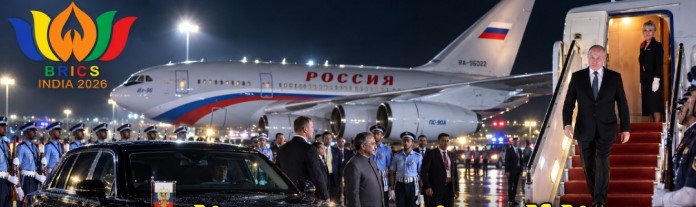
Talks with Putin are expected to cover energy, defence, trade, investment and the conflict in Ukraine. Russia remains an important source of crude oil, defence equipment and fertilisers for India. Prime Minister Narendra Modi has maintained regular contact with both Putin and Ukrainian President Volodymyr Zelenskyy. India has consistently called for dialogue and diplomacy to end the conflict.
The expected meeting with Pezeshkian will have a strong energy and regional security dimension. Developments in West Asia and continued pressure on important shipping routes have made stable energy supplies a serious concern for India and other importing countries including China.
India has placed resilience, innovation, cooperation and sustainability at the centre of its BRICS presidency. The theme gives BRICS a new expression: “Building Resilience and Innovation for Cooperation and Sustainability.” The approach reflects India’s effort to make the grouping more people-centric. New Delhi wants BRICS cooperation to produce visible results in technology, health, food security, energy, development and digital public infrastructure.
BRICS began as a platform bringing together Brazil, Russia, India, China and South Africa. It has since expanded to include major developing economies from Africa, West Asia and Southeast Asia. The expanded grouping represents nearly half the world’s population and a substantial share of global economic output and energy resources. Its wider reach has increased its influence, but it has also brought countries with different political systems and foreign policy priorities under one umbrella.
BRICS is not a military alliance like NATO. Nor is it a political and economic union on the lines of the European Union. It works mainly through consultation and consensus on economic, financial and global governance issues.
That flexibility is important for India. New Delhi is also a member of the Quad and the Shanghai Cooperation Organisation. It maintains strong strategic relations with the United States and Europe while continuing its longstanding partnership with Russia and managing a complex relationship with China.
India’s approach has gradually moved from traditional non-alignment towards multi-alignment. It allows New Delhi to work with different countries on different issues without becoming part of an exclusive geopolitical camp. The Quad serves India’s interests in the Indo-Pacific, especially in maritime security, technology and resilient supply chains. The SCO offers a platform for engagement with Russia, China and Central Asia. BRICS gives India a wider forum to raise the concerns of developing countries and the Global South.
The summit will test whether the expanded grouping can build consensus despite the different priorities of its members. India is expected to keep the focus on practical cooperation, reform of global institutions and a stronger voice for the Global South.
New Delhi is also expected to renew its call for reforms in the United Nations Security Council and global financial institutions. India has maintained that these bodies must reflect present-day economic and demographic realities and give developing countries a greater voice.
Local-currency trade and cross-border payment systems may also figure in the discussions. BRICS members have been exploring ways to reduce transaction costs and build alternative financial channels. India, however, has avoided presenting the grouping as an anti-West platform.
Security was tightened across the capital ahead of the gathering. Government offices and schools remained closed on Friday, while traffic diversions were introduced along routes used by visiting delegations.
The formal deliberations will begin on Saturday. Prime Minister Narendra Modi’s opening address, his meetings with key leaders and the final language of the New Delhi Declaration will show whether the summit can turn the growing weight of BRICS into practical cooperation.