On International Youth Day, India showcases the potential of its young population. With over 60% under 35, they are pivotal for the nation's future in technology, education, and governance.
New Delhi/Bhopal, August 12, 2026
As the world marks International Youth Day on August 12, India enters the conversation with an advantage few countries can match- the sheer strength of its young population. According to sources more than 60 per cent of Indians are below the age of 35, giving the country a demographic force that could play a defining role in its economic, social and national journey over the coming decades.
The global picture is different. The United Nations defines youth, for statistical purposes, as people between 15 and 24 years of age. Around 1.2 billion people fall in this group worldwide, accounting for about 16 per cent of the global population. International Youth Day has been observed every August 12 since 2000 to draw attention to the aspirations, participation and challenges of young people.
For India, however, youth carries a meaning beyond numbers. A large part of today's young generation was born in an India very different from the one experienced by their grandparents and great-grandparents. They did not see the freedom struggle. They know the sacrifices of Bhagat Singh, Chandrashekhar Azad, Subhas Chandra Bose, Mahatma Gandhi, Sardar Vallabhbhai Patel, Tilak and countless other freedom fighters largely through textbooks, films, family memories and public commemorations.
They did not experience colonial rule or witness the long struggle that preceded Independence. Even the difficult early decades after 1947 belong to history for much of this generation.
Today's young Indian has instead grown up with mobile phones, the internet, social media, digital payments, expanding highways, new airports, start-ups and instant access to information from around the world. For Generation Z, and increasingly Generation Alpha, the smartphone is not simply a communication device. It is a classroom, marketplace, television screen, newspaper, bank, workplace and social space rolled into one.
That has produced a generation with enormous exposure. It has also produced new challenges. Information arrives in seconds, but wisdom does not. Opportunities have multiplied, but so have distractions. Social media has given young people a powerful voice, while also exposing them to misinformation, comparison, instant judgement and the pressure to react before reflecting.
This is where India's demographic advantage meets its real test. A young population by itself does not guarantees a developed nation. It needs education. It needs skills. It needs employment and entrepreneurship. But equally, it needs confidence, discipline, social responsibility and an understanding of the country to which it belongs.
The government itself recognises this connection. Its National Youth Day framework places young Indians not merely as beneficiaries of development but as participants in nation-building. Programmes covering skills, entrepreneurship, volunteering, fitness and civic participation are intended to convert demographic strength into productive capacity.
Prime Minister Narendra Modi has repeatedly linked Yuva Shakti with the goal of Viksit Bharat. At the Viksit Bharat Young Leaders Dialogue earlier this year, young participants presented ideas directly before the national leadership across different sectors. The exercise sought to give youth a role in shaping policy conversations rather than leaving them outside the room.
Yet government responsibility cannot end with schemes, training programmes or employment figures. The larger task is to create an environment where young people can question, innovate and compete without losing their sense of responsibility towards society. A skilled engineer strengthens the economy. A successful entrepreneur creates employment. A scientist expands knowledge. A soldier protects the country. A farmer using technology improves productivity. But a responsible citizen strengthens democracy itself.
That distinction matters.
Young people today encounter political leaders directly through Instagram, YouTube, X and other digital platforms. Speeches, policy announcements and political disagreements reach their phones without waiting for the next day's newspaper or television bulletin. For many young Indians, these leaders are also the governments they have actually experienced.
Their understanding of older political eras comes largely through history and inherited memory. Their judgement of today's leadership, however, is being formed in real time — through education, jobs, public services, opportunities and their everyday experience of governance.
That places responsibility on political leadership too. Young people cannot simply be viewed as voters, social-media followers or crowds at political rallies. Their questions about jobs, education, technology, the environment, social mobility and opportunities deserve serious engagement. A country with such a large young population must listen to its youth as much as it seeks to guide them.
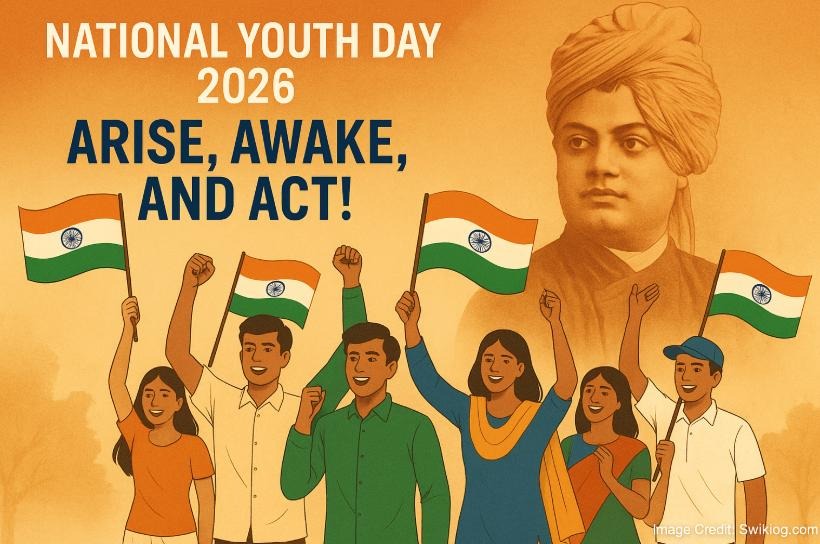
India also has its own Youth Day with a distinctly civilisational character.
January 12, the birth anniversary of Swami Vivekananda, is observed as National Youth Day. The Government of India has celebrated the occasion since 1985, drawing inspiration from Vivekananda's ideas on character, courage, self-confidence, service and nation-building. That connection remains strikingly relevant.
Vivekananda spoke to young people long before smartphones, artificial intelligence or the modern start-up economy existed. Yet his emphasis was fundamentally on human capacity- strength of character, confidence in oneself and service to society.
The Government's National Youth Day message this year similarly described his ideas on character, courage and nation-building as continuing sources of inspiration for young Indians. Therein lies perhaps the bridge between August 12 and January 12.
International Youth Day reminds India that its young people are part of a global generation confronting rapid technological, economic and social change.
National Youth Day reminds them of something closer home-that progress must also carry purpose. India's young population can become its greatest strength. But that will depend on what opportunities the country creates and what values accompany those opportunities.
Governments must provide quality education, skills, employment pathways and space for innovation. Families and educational institutions have an equally important role in building character, discipline and social sensitivity. Young people themselves must ultimately decide what they do with the opportunities placed before them.
By 2047, when India completes 100 years of Independence, today's teenagers and young adults will be among the country's professionals, entrepreneurs, administrators, scientists, teachers, political leaders and decision-makers.
They did not witness the struggle that gave India its freedom. But they will help decide what India does with that freedom. That is why India's youth dividend is much more than a population statistic. Properly educated, skilled and guided by values, this generation can become the force that carries the country from the memory of its freedom struggle towards the responsibility of building its future.