Chinese President Xi Jinping's visit to India for the BRICS Summit could signal a major shift in India-China relations amid global geopolitical changes.
Kathmandu/ New Delhi
By Bipin Deo

Four decades ago, Singapore's founding Prime Minister Lee Kuan Yew thanked the United States for leading the world towards globalization and economic liberalization. That era fundamentally reshaped the global economy. Until the early nineteenth century, India and China together accounted for nearly half of the world's economic output. Colonialism and the Industrial Revolution shifted the centre of gravity to the Atlantic world, but globalization once again propelled Asia to the forefront.
Countries such as China, South Korea, Japan, the ASEAN economies and, increasingly, India leveraged open markets and global trade to transform their economies. The economic centre of gravity gradually moved from the transatlantic to the Indo-Pacific region. Today, however, the liberal international order is under strain. Rising protectionism, particularly under the second Trump administration, has challenged the very principles of free trade that fuelled Asia's rise. The more the United States resorts to punitive tariffs, the more it risks weakening its own leadership in the global economic order.
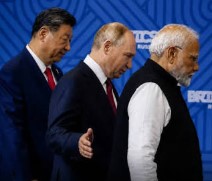
It is against this backdrop that India will host the BRICS Summit on September 12-13, where Chinese President Xi Jinping and Russian President Vladimir Putin are expected to participate. Xi's visit could mark an important turning point in India-China relations, which remain at a delicate crossroads.
Although New Delhi and Beijing established nearly thirty dialogue mechanisms over the years to manage bilateral relations, many of these channels have either become inactive or lost their effectiveness following the border tensions of recent years. Meanwhile, China's growing use of "grey-zone" tactics—including restrictions on exports of rare earth materials and strategic electronic components—has underscored its willingness to employ economic coercion as an instrument of statecraft.
China's deepening strategic partnership with Pakistan continues to cast a long shadow over Sino-Indian ties. Beijing's support for Pakistan's military establishment has consistently complicated India's security environment. Many observers argue that China's concerns about India extend beyond geopolitics. As the world's largest democracy and one of the fastest-growing major economies, India presents an alternative political and developmental model that contrasts sharply with China's authoritarian system.
Unlike the former Soviet Union, China does not actively seek to export communism. However, it remains deeply wary of democratic influences while ensuring that the Communist Party retains complete control over the state. In China, the Party is not merely part of the state—it is the state.
Another enduring reality is that China's perception of India is heavily influenced by New Delhi's growing strategic partnership with the United States. As India strengthens defence cooperation with Washington through agreements such as BECA and COMCASA, Beijing inevitably views New Delhi with greater strategic caution.
Yet India differs fundamentally from many of America's security partners in Asia. Unlike Japan or South Korea, India retains strategic autonomy while steadily expanding its military and economic capabilities. It is among the few major Asian powers capable of independently shaping the regional balance of power.
India's expanding defence engagement with Southeast Asia has also attracted Beijing's attention. The export of BrahMos supersonic cruise missiles to countries such as the Philippines, and discussions with Indonesia and Vietnam, reflect India's growing role as a security provider in the Indo-Pacific. At the same time, China's increasingly assertive behaviour in the South China Sea has generated unease among several ASEAN nations, creating new strategic opportunities for India.
China is also reassessing certain aspects of its Pakistan policy. Repeated attacks on Chinese personnel and projects under the China-Pakistan Economic Corridor (CPEC) have exposed the limitations of Pakistan's ability to safeguard Chinese investments. These developments may encourage Beijing to diversify its regional partnerships and reduce its excessive dependence on Islamabad.
There are already signs of cautious economic engagement between India and China. Beijing has shown greater openness towards imports of certain Indian engineering and electronic products, while the reopening of the Nathula border has revived prospects for increased bilateral trade. These developments suggest that despite political tensions, both countries recognise the importance of maintaining economic engagement.
From Beijing's perspective, Xi Jinping's participation in the BRICS Summit is likely to serve multiple strategic objectives. It will reinforce the image of China, India and Russia engaging on common global platforms while advancing discussions on de-dollarisation and financial cooperation among emerging economies. It will also signal that BRICS continues to provide an alternative voice in global governance.
Economic compulsions further strengthen China's interest in engaging India. Slowing demand in Europe, continuing trade frictions with the United States and instability across West Asia have increased the importance of the Indian market. As the world's fastest-growing major economy and the most populous nation, India represents one of China's most attractive long-term export destinations.
For India, however, managing China ultimately depends on strengthening its own economic foundations. As former Foreign Secretary Shyam Saran argues in How China Sees India and the World, sustained economic growth remains India's most effective strategic instrument. Around 2005, when India was growing rapidly, China softened its position on Sikkim's status, reflecting how economic strength can reshape diplomatic calculations. During the same period, India concluded the landmark Civil Nuclear Agreement with the United States—described by former Prime Minister Dr. Manmohan Singh in The Accidental Prime Minister as one of his government's greatest achievements.
China combines economic leverage, strategic signalling and sophisticated information operations in pursuit of its national objectives. Former Foreign Secretary Vijay Gokhale, in The Long Game, explains how Beijing patiently exploits opportunities while leveraging crises to its advantage. India's China policy must therefore be grounded in a clear understanding of both Chinese strategy and Chinese tactics.
Diplomacy is ultimately about leverage. India possesses significant advantages: its strategic location astride the Indian Ocean, its civilisational influence across Asia, its democratic legitimacy, its youthful population and its expanding economic weight. These strengths provide New Delhi with considerable bargaining power.
Xi Jinping's visit should therefore not be viewed merely as a ceremonial event. It presents India with an opportunity to engage China from a position of growing confidence. New Delhi must remain firm on its core interests while exploring areas of mutual benefit. In a rapidly changing global order, successful diplomacy will depend not only on managing differences but also on using India's expanding strategic leverage with wisdom and confidence.
(The writer is a geopolitics expert based in Kathmandu, Nepal)