BJP launches nationwide anti-mobocracy campaign, expanding outreach in Madhya Pradesh amid Opposition protests and electoral reform row.
New Delhi/ Bhopal, October 24, 2026
The growing political confrontation over electoral reforms and the functioning of constitutional institutions has opened another front. This time, the Bharatiya Janata Party (BJP) is taking its battle against the Opposition beyond political platforms to streets, colleges and grassroots organisations.
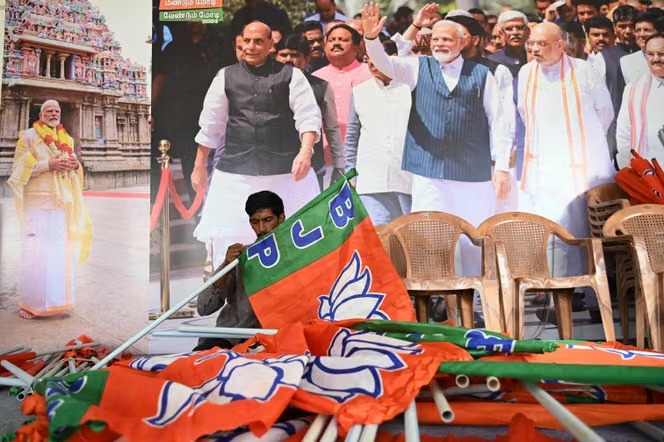
Under its nationwide campaign, Loktantra Bachao, Bheedtantra Hatao (Save Democracy, Remove Mobocracy), the BJP is seeking to counter what it describes as attempts to create unrest and weaken public confidence in India's democratic institutions.
According to reports, the campaign began nationally on October 22. In Madhya Pradesh, the party is launching its outreach programme from Saturday, October 24, with activities scheduled until November 5.
The move comes amid recent protests in Delhi, Opposition allegations against the Election Commission and a growing debate over the difference between peaceful democratic protests and unlawful political pressure.
The campaign also gives the BJP an opportunity to reach young people, including those who may not share its political views, and explain its stand on electoral reforms. Madhya Pradesh BJP president Hemant Khandelwal has asked party workers to take the campaign to the booth level and engage directly with citizens. At a preparatory meeting in Bhopal, senior party leaders discussed programmes involving students, teachers, intellectuals, social organisations and young professionals. Union Minister Bhupender Yadav and Khandelwal joined the meeting virtually, according to reports.
The party plans public meetings, foot marches, press conferences and discussions in educational institutions. Ministers, MPs, MLAs and senior organisational leaders have been assigned responsibilities. Khandelwal has accused the Congress and other Opposition parties of spreading confusion over the Special Intensive Revision (SIR) of electoral rolls. He has asked BJP workers to counter these allegations with facts and explain the electoral revision process to ordinary voters.
The BJP also plans to raise the Emergency imposed in 1975 and the 1984 anti-Sikh riots while questioning the Congress's democratic record.
The immediate political background is the continuing confrontation over the Election Commission and electoral roll revisions. Congress leader Rahul Gandhi and other Opposition leaders have questioned the transparency of the SIR exercise. They have also demanded accountability from Chief Election Commissioner Gyanesh Kumar.
The BJP rejects these allegations and maintains that electoral roll verification is necessary to remove ineligible entries and protect the integrity of elections. The Opposition, however, argues that such exercises must not result in genuine voters losing their names from electoral rolls.
The BJP's latest campaign is therefore more than a routine political programme. It represents an organised attempt to challenge the Opposition's narrative and build public support for the electoral process.
The debate has gained further significance following RSS chief Mohan Bhagwat's Vijayadashami address in Nagpur on October 20. Referring to political unrest in Bangladesh, Nepal and some European countries, Bhagwat cautioned against movements that promise solutions simply through a change of government. He argued that replacing a government does not automatically resolve society's deeper problems. Bhagwat acknowledged that protests over public grievances are natural in a democracy. However, he emphasised that protesters, political leaders and authorities must remain within constitutional and legal limits.
He also warned that political interests could exploit public movements and create divisions within society. His remarks reflect the RSS's emphasis on social harmony, national unity and constitutional conduct. They also provide a wider ideological context to the BJP's campaign against what it calls mobocracy.
The word mobocracy has increasingly entered political discussions. In simple terms, it describes a situation where organised crowds try to impose their demands through intimidation, violence or unlawful pressure instead of established democratic procedures. However, every public demonstration cannot be described as mobocracy.
Citizens protesting against government policies, students questioning examination irregularities or farmers demanding better prices are exercising their democratic rights when their protests remain peaceful. The problem begins when demonstrations turn violent, public property is damaged, people are threatened or others are prevented from exercising their lawful rights.
Dr B.R. Ambedkar addressed this issue while speaking in the Constituent Assembly on November 25, 1949. He warned against abandoning constitutional methods for achieving political and social objectives once democratic institutions were available. His remarks were made when India was preparing to begin its journey as a constitutional democracy. They remain relevant to present political disagreements. However, they should not be interpreted as a rejection of the constitutional right to peaceful protest. Article 19 of the Constitution protects freedom of expression and peaceful assembly, subject to reasonable restrictions. The Supreme Court has also recognised peaceful protest as an important democratic right. At the same time, the courts have maintained that public demonstrations must respect the rights of other citizens.
Under Prime Minister Narendra Modi's leadership, the government has repeatedly highlighted constitutional values, public participation and institutional stability as important elements of India's development journey. However, the strength of democracy also depends on how governments respond to criticism and how Opposition parties conduct their protests.
Recent political confrontations have shown how quickly disagreements can turn into questions about the credibility of institutions. Social media has added another dimension. Political messages spread rapidly, while allegations often reach millions before their accuracy is established. This places greater responsibility on political leaders, public institutions and the media.
The BJP's campaign is expected to intensify political debate over the coming days, particularly among students, young voters and civil society groups. Its success will depend not merely on the number of meetings held but also on whether the party can answer public concerns with convincing facts. The Opposition, meanwhile, faces the responsibility of ensuring that its protests remain peaceful and its allegations are backed by evidence.
India's democratic strength has always rested on elections, public participation, independent institutions and the freedom to disagree.
The larger message emerging from this political confrontation is that democracy needs both a responsible government and a responsible Opposition. Protecting constitutional institutions is important, but so is protecting the voice of every citizen. The two must go together if democracy is to remain strong.