The Janjatiya Gaurav Pakhwada will feature 302 development projects, welfare camps, digital platforms and cultural programmes across 19 states and Union Territories.
New Delhi/Bhopal, October 29, 2026
More than a century after Bhagwan Birsa Munda led a historic struggle for tribal rights and dignity, his legacy continues to inspire India's efforts towards tribal empowerment. The Centre is now preparing a nationwide campaign that seeks to connect this historical legacy with education, healthcare, livelihood opportunities and development in tribal villages.
The Ministry of Tribal Affairs will observe Janjatiya Gaurav Pakhwada from November 1 to 15, culminating in Janjatiya Gaurav Diwas on November 15, the birth anniversary of Bhagwan Birsa Munda. The fortnight will bring together cultural programmes, welfare camps, development projects and community participation across several states.
According to the Ministry of Tribal Affairs, the campaign is intended not merely to honour tribal freedom fighters but also to ensure that government welfare schemes reach families living in remote and underserved areas.
Born on November 15, 1875, in Ulihatu village in present-day Jharkhand, Birsa Munda emerged as one of the most influential tribal leaders during British rule. At a time when colonial policies and exploitative land arrangements threatened traditional tribal communities, he mobilised people to defend their land, forests and way of life.
His movement, popularly known as Ulgulan, or the Great Tumult, challenged British authority and the exploitation of tribal communities by landlords and moneylenders. Birsa Munda was also a social and spiritual reformer who encouraged his followers to preserve their identity and resist injustice. He died in Ranchi Jail on June 9, 1900, at just 25 years of age.
Although his life was short, his struggle left a lasting impression on India's freedom movement. Remembered as Dharti Aaba, or Father of the Earth, Birsa Munda remains a powerful symbol of tribal pride, self-respect and resistance against exploitation.
The government led by Prime Minister Narendra Modi declared November 15 as Janjatiya Gaurav Diwas in 2021 to recognise the contribution of tribal communities to India's freedom struggle. The decision also brought greater national attention to tribal heroes whose contributions had received relatively limited recognition in mainstream historical narratives. The 150th birth anniversary of Birsa Munda was commemorated during 2024–25 through Janjatiya Gaurav Varsh.
The Centre has lined up 302 development projects during the campaign. Of these, 228 projects are ready for inauguration, while foundation stones will be laid for another 74. Among the major initiatives are a new Tribal Research Institute building in Itanagar, Arunachal Pradesh, and the Ropuiliani Tribal Freedom Fighter Museum in Mizoram. These institutions are expected to support research into tribal history and help preserve the cultural heritage of different communities.
The campaign will also include programmes related to education, healthcare, employment and forest rights. The Ministry has planned more than 160 state-level activities across 19 states and Union Territories.
Health and nutrition camps are also being organised for Particularly Vulnerable Tribal Groups under the PM-JANMAN initiative. The programme is part of the Centre's wider tribal development strategy, which includes the Dharti Aaba Janjatiya Gram Utkarsh Abhiyan. These initiatives seek to improve basic facilities in tribal settlements, particularly housing, roads, drinking water, education and healthcare.
The government is also training approximately 1.54 lakh Adi Karmayogi volunteers across 76,963 villages to strengthen community participation and awareness of welfare schemes. Their involvement is expected to help connect local communities with government departments and development programmes.
Two national digital platforms are scheduled for launch during the fortnight. The Jan-HIT portal, developed in collaboration with the Indian Council of Medical Research, will provide tribe-specific health information covering 20 states.
Another important initiative is the National Forest Rights Act Digital Platform. It aims to bring the process of forest rights claims, from applications submitted through Gram Sabhas to the issuance of digitally signed titles, onto a common digital system.
Around 200 students from Eklavya Model Residential Schools are scheduled to interact with President Droupadi Murmu at Rashtrapati Bhavan on November 12. A National Tribal Literary Festival will be organised in New Delhi on November 12 and 13 to promote tribal languages, literature and oral traditions. The Rani Durgavati Adivasi Mahila Sammelan on November 14 will bring together around 500 tribal women entrepreneurs from across the country.
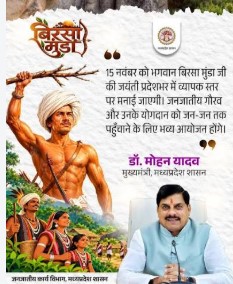
Madhya Pradesh has a rich history of tribal resistance against colonial rule. Freedom fighters such as Tantya Bhil, Raja Shankar Shah, Kunwar Raghunath Shah and Badal Bhoi are remembered for their courage and sacrifice. The state also takes pride in the legacy of Rani Durgavati, who fought against Mughal expansion.
Home to one of India's largest tribal populations, Madhya Pradesh has a diverse cultural heritage represented by Gond, Bhil, Baiga, Sahariya and Korku communities. Museums in Jabalpur and Chhindwara have also helped preserve the contributions of tribal heroes. The nationwide campaign will bring renewed attention to this heritage while focusing on education, healthcare, employment and better living conditions in tribal areas.
Birsa Munda's struggle for land rights, dignity and self-respect continues to inspire tribal communities across India. Janjatiya Gaurav Pakhwada seeks to carry forward his legacy by honouring tribal heroes and bringing development opportunities closer to the communities they represented.