PM Narendra Modi’s ‘Naraz Phupha’ jibe has caught public attention, using familiar Indian family humour to target habitual criticism and stir a fresh political debate.
New Delhi/ Bhopal, September 9, 2026
Prime Minister Narendra Modi has brought a familiar character from the Indian wedding into the country’s political conversation: the “Naraz Phupha”. Used twice by Modi within four days, the expression has moved quickly from public speeches to social media and political exchanges. It has also prompted an obvious question: Who exactly is this “Naraz Phupha”?.
Modi first used the analogy at the centenary celebrations of Shri Ram College of Commerce in Delhi on September 5. Addressing students, he said they would meet two kinds of people after leaving the campus. The first would use the strength of society to build the nation. The second would turn into a “Naraz Phupha” whenever a new project was announced. Their standard response, he remarked, would be: “Iski kya zaroorat hai?”
Modi recalled the opposition and questions surrounding the Statue of Unity, high-speed rail, UPI, semiconductor manufacturing, the new Parliament building and memorials for the armed forces. His message was clear: habitual criticism should not stop the country from taking decisions considered necessary for its future.
The Prime Minister did not name any political leader. But in politics, an unnamed target often attracts more attention than a named one. Social media users and political observers began speculating whether the jibe was aimed at Leader of Opposition Rahul Gandhi, Congress president Mallikarjuna Kharge or opposition parties collectively. Only Modi can say if he had any particular person in mind.
Prime Minister Narendra Modi returned to the same expression in Vadodara on September 8. This time, it came while he was speaking about the dedicated freight corridors. Modi said a double-stack container train had recently carried goods equivalent to more than 250 trucks from JNPT near Mumbai to Vadodara. He then imagined the “Naraz Phupha” raising fresh objections: What will happen to truck operators? Where will the trucks go? What about those who purchased them? “Now Phupha ji has found work,” he remarked.
The Prime Minister said the freight corridor would allow larger quantities of goods to move faster across the country. He was addressing the “Namo for Viksit Bharat” programme, where development projects worth more than Rs 35,000 crore were inaugurated or launched.
The repetition gave the phrase a political life of its own; The humorous expression has appeared twice in his speeches within four days. It has since triggered a wider political exchange, with the Congress accusing the Prime Minister of using a new label to dismiss criticism. Kharge responded by accusing Modi of inventing a new label for the opposition every year. He said criticism and questions were part of democracy and raised concerns over unemployment, examination paper leaks, expensive education and declining scholarships. BJP president Nitin Nabin defended the Prime Minister and accused the opposition of maintaining a negative approach towards the country’s progress.
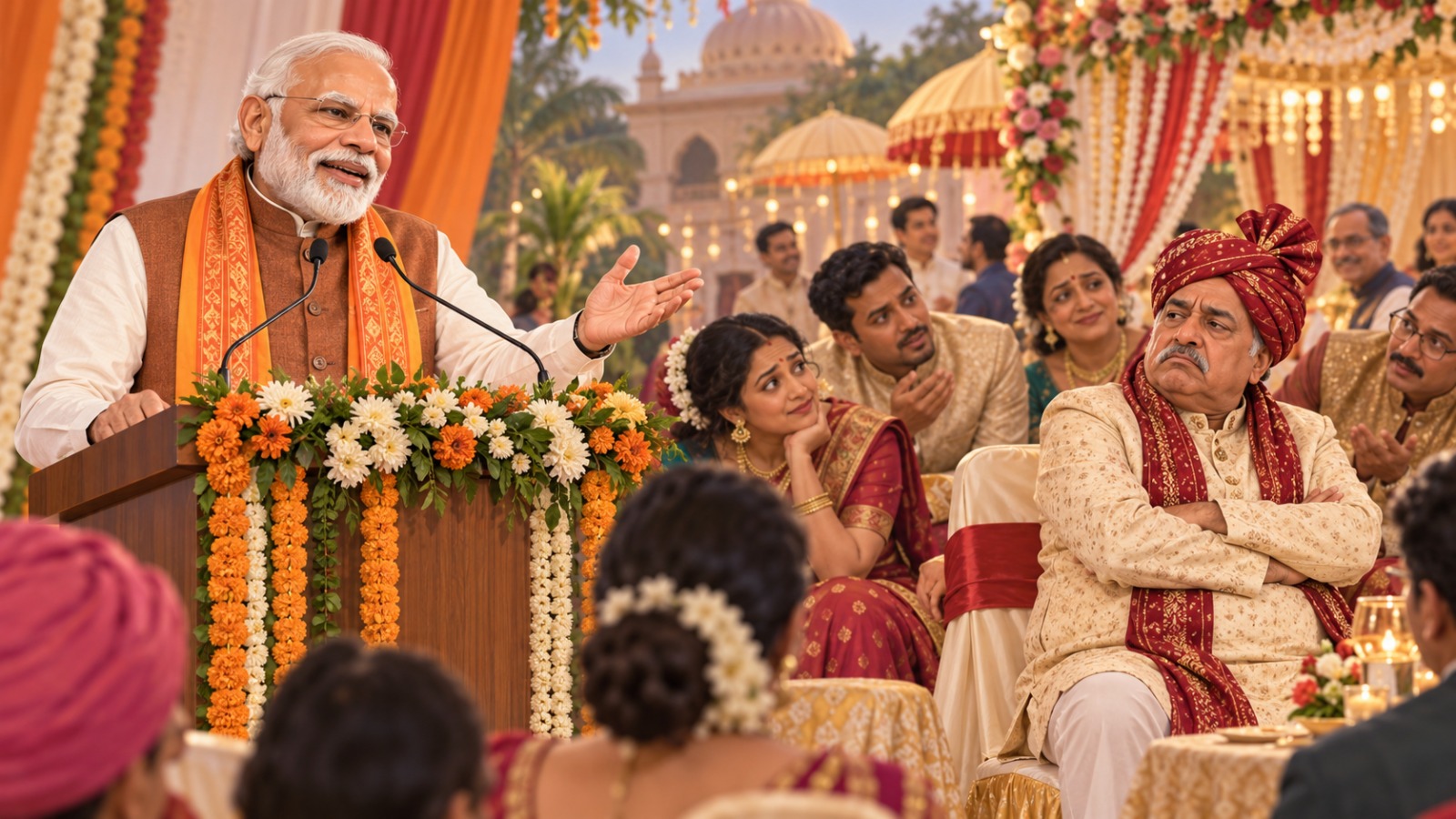
Behind this political exchange lies a character almost every Indian family recognizes; A phupha is the husband of one’s father’s sister. In popular humour, especially during weddings and large family gatherings, the “Naraz Phupha” is the senior relative who appears unhappy even when nobody is certain what went wrong.
A quiet family investigation soon begins. Was he not received properly? Was somebody else offered tea first? Was his chair too far from the stage? Did the photographer miss him? Or was another relative shown greater respect?
The reason may be small, but the entire family becomes involved in restoring his mood. His anger is discussed, decoded and finally accommodated so that the wedding can proceed peacefully.
This is also what makes Modi’s analogy different from a harsh political label. A phupha may complain, criticise or sit away from the gathering, but he remains part of the family. He is an adversary at the dinner table, not an enemy outside the door.
The metaphor therefore carries more than political sarcasm. It draws upon an Indian social tradition in which disagreement does not necessarily end a relationship. Arguments may be sharp, but the door for reconciliation remains open. That perhaps explains why “Naraz Phupha” has found such quick resonance. It combines humour, irritation and affection in two familiar words.
Indian politics will continue to witness criticism, counter-criticism and disagreement over major policies. The “Naraz Phupha” may remain unhappy and the rest of the family may continue wondering why. But the gathering carries on, conversation resumes and, sooner or later, everyone returns to the same table.