India observes October 2nd to honor Mahatma Gandhi and Lal Bahadur Shastri. Shastri, its second PM, led during 1965’s war with Pakistan and food scarcity. His 'Jai Jawan, Jai Kisan' slogan united soldiers and farmers. Though controversial politically, his efforts laid groundwork for India’s Green Revolution. His unexpected death at Tashkent in 1966 reshaped diplomatic relations with Pakistan, leaving a legacy of simplicity and resolve
New Delhi/ Bhopal, October 2, 2026
October 2 brings together the memories of two men who left a lasting mark on India. The country remembers Mahatma Gandhi on his birth anniversary. It also remembers Lal Bahadur Shastri, India's second Prime Minister, whose short tenure came at one of the most difficult moments in the young Republic.
Prime Minister Narendra Modi paid homage to both leaders on Friday. At Vijay Ghat, he remembered Shastri and later said his simplicity and dedication to the nation continue to inspire the country. He described Shastri as gentle in personality but firm in resolve.
That resolve was tested severely in 1965. India was fighting a war with Pakistan. At home, the country was struggling with drought, rising food prices and a serious shortage of foodgrain. India depended heavily on imported wheat, particularly supplies coming from the United States.
Shastri's response brought the soldier and the farmer into the same national conversation. “Jai Jawan, Jai Kisan” became the defining call of his leadership. The soldier had to protect the country's borders. The farmer had to strengthen its food security. The slogan given by Shastri in 1965 has remained part of India's public vocabulary ever since.
But there was another call from Shastri that revealed something about the man himself. As food shortages became serious, he appealed to Indians to voluntarily give up a meal. His family followed the practice too. Restaurants and households in several parts of the country began skipping the Monday evening meal. The practice came to be popularly remembered as the “Shastri Vrat”.
It was a remarkably simple response to a very complicated problem. The fast could not produce foodgrain. But it could make people part of the crisis confronting the country. Shastri was asking citizens to conserve food while his government worked on the larger problem of agricultural production.
Behind that public appeal, a much bigger change was beginning. Agriculture was given greater priority. New seeds, fertilisers and irrigation received attention. The Food Corporation of India was established in 1965 when the country was facing a major shortage of foodgrain, particularly wheat.
Agriculture Minister C. Subramaniam, scientists including M.S. Swaminathan and others pushed the new agricultural strategy. Shastri backed the import and testing of high-yielding wheat varieties in 1965. The programme expanded considerably after his death and became central to what came to be known as India's Green Revolution.
The changes however, were not without political disagreement. The communist’s movement points to criticism of his economic and agricultural approach and political attacks against his government. The period was indeed politically turbulent. The Communist Party of India had split in 1964, giving birth to the CPI(M). Shastri's government also faced criticism in Parliament over economic policy, food shortages and other issues.
But his tenure would ultimately be remembered more for two challenges that unfolded almost together: food security and war. The 1965 conflict put Shastri, who had succeeded Jawaharlal Nehru only in June 1964, in charge of India's first major war after the traumatic 1962 conflict with China.
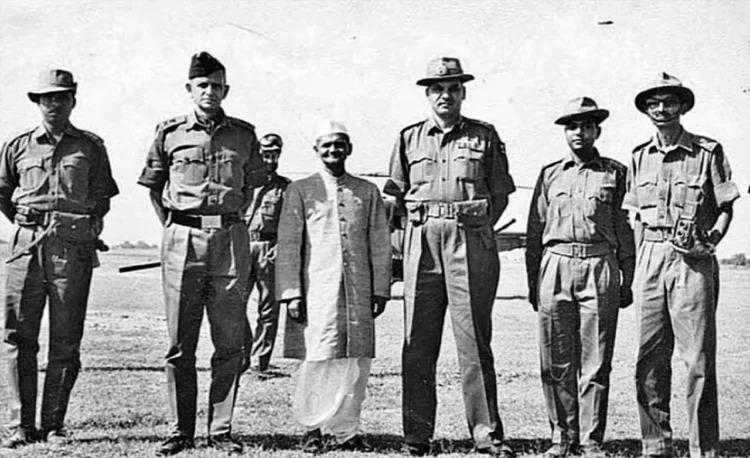
His understated public personality was very different from the scale of the decisions before him. The war eventually gave way to diplomacy. Shastri travelled to Tashkent, then in the Soviet Union, for talks with Pakistan President Ayub Khan. On January 10, 1966, the two sides signed the Tashkent Declaration. India and Pakistan agreed to restore peaceful relations and withdraw their armed personnel to positions held before August 5, 1965.
Then came the event that forever attached Tashkent to Shastri's name. He died there reportedly under mysterious circumstance in the early hours of January 11, only hours after the declaration was signed. His death at the age of 61 brought an abrupt end to a prime ministership that had lasted barely 19 months.
Yet those months produced some of the most enduring images of Indian public life. There was Shastri asking families to miss a meal when food was scarce. There was the call of “Jai Jawan, Jai Kisan” when soldiers were fighting on the border and farmers were being asked to produce more at home. And there was the larger push towards agricultural self-reliance at a time when India remained dependent on imported grain.
His personal life strengthened that image. The official account of his life describes a leader shaped by modest beginnings, the freedom struggle and years spent in British prisons. It remembers him for integrity, humility and an inner firmness that was often hidden behind his soft-spoken personality.
Six decades later, India is very different from the country Shastri governed. But October 2 keeps returning to the same memory. A leader with little interest in personal display was asked to steer India through war and scarcity. His answer was equally simple: strengthen the soldier, strengthen the farmer and ask the citizen to share the burden. That is perhaps why “Jai Jawan, Jai Kisan” has lived much longer than the brief tenure of the man who gave India those words.