Following the 2025 Pahalgam terror attack, India has suspended the Indus Waters Treaty, linking future cooperation to actions against terrorism by Pakistan.
New Delhi/ Bhopal July 1, 2026
India has maintained its firm position that the Indus Waters Treaty (IWT) will remain in abeyance until Pakistan takes credible and irreversible steps to end cross-border terrorism. The stand comes as Islamabad stepped up its rhetoric over New Delhi's decision to suspend the six-decade-old water-sharing agreement following the 2025 Pahalgam terror attack. There was no immediate response from New Delhi to Pakistan's latest remarks. However, India has already made its position clear at the international level.
Earlier, speaking at a United Nations event on World Water Day 2026, India's Permanent Representative Harish Parvathaneni said New Delhi was compelled to place the treaty in abeyance after repeated provocations and the failure of bilateral engagement. He said the treaty would remain suspended until Pakistan takes credible and irreversible steps to end support for terrorism.
Prime Minister Narendra Modi has also repeatedly underlined India's position. He has asserted that "blood and water cannot flow together." The Prime Minister has consistently linked any future engagement with Pakistan, including cooperation under the Indus Waters Treaty, to decisive action against cross-border terrorism.
According to media and agency reports from Islamabad, Pakistan's leadership used an international conference on the Indus Waters Treaty to criticise India's decision. The conference focused on the future of the treaty after New Delhi placed it in abeyance.
Pakistan's Climate Change Minister Musadik Malik warned that Islamabad would "cut off the hands" of anyone attempting to claim Pakistan's share of water. He described the Indus River as Pakistan's lifeline. He said it should neither become a bargaining chip nor a political weapon. Malik also argued that the future of the treaty would determine the credibility of international agreements.
The reports said Pakistan's Deputy Prime Minister Ishaq Dar termed India's decision "illegal". He claimed no country could unilaterally suspend a treaty that contains no such provision. Dar also repeated Islamabad's stand that any attempt to divert or reduce Pakistan's share of water would have serious consequences for regional peace and security. He referred to Pakistan's earlier position that such a move would be treated as an "act of war."
Pakistan Peoples Party chairman and former foreign minister Bilawal Bhutto Zardari also criticized India's decision. He said the Indus River was "not open for negotiations." He proposed an international convention against the "weaponization of waterways." Bilawal also warned that any attempt to undermine Pakistan's water rights would invite what he described as a national response.
India suspended its participation in the treaty after the April 2025 Pahalgam terror attack. The attack claimed the lives of 26 tourists in Jammu and Kashmir. New Delhi blamed Pakistan-based terrorists for the strike. Islamabad denied the allegation.
The attack triggered one of the sharpest downturns in bilateral ties in recent years. India downgraded diplomatic and trade relations with Pakistan. The main land border crossing was closed. Both countries suspended visas for each other's nationals. India later launched Operation Sindoor against terrorist infrastructure across the border in May 2025. Relations between the two neighbours have remained frozen since then.
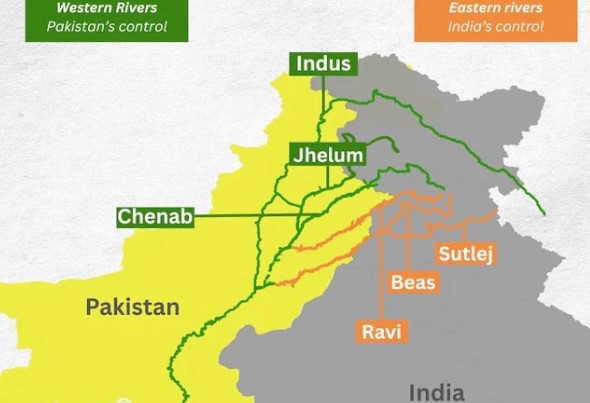
Brokered by the World Bank and signed in 1960, the Indus Waters Treaty governs the sharing of the Indus river system. India controls the eastern rivers—Ravi, Beas and Sutlej. Pakistan receives the waters of the western rivers—Indus, Jhelum and Chenab.
The treaty survived the wars of 1965, 1971 and the 1999 Kargil conflict. It remained one of the few enduring agreements between the two neighbours for decades. Today, however, it faces its toughest test as India maintains that meaningful cooperation cannot continue alongside cross-border terrorism.