The early melting of the Amarnath ice lingam and increased pilgrim numbers in 2026 prompts a reflection on deeper spiritual meanings and the importance of restraint.
New Delhi, July 13, 2026
Mayank Chandra

There is a longing that stirs in every devotee of Shiva, a pull towards the icy heights of the Himalayas where nature herself fashions a lingam of ice each year. To bow one's head at the feet of Baba Barfani is among the oldest aspirations of the faithful. The Amarnath cave, resting at nearly 3,880 metres in the mountains of south Kashmir, has drawn pilgrims for centuries. The journey is hard. The air is thin. The path is unforgiving. And yet they come, in their lakhs, because faith does not measure distance the way the body does.
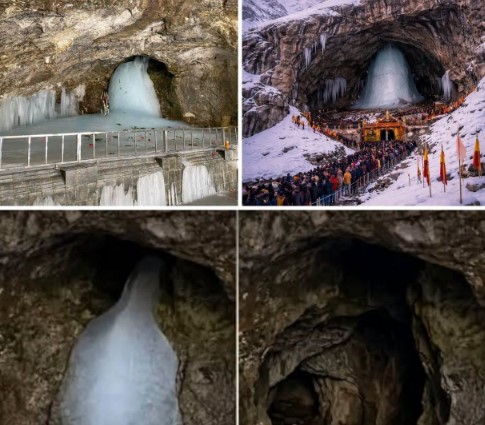
This year, something has happened that invites a pause. The naturally formed ice Shivling melted early. Photographs from the cave showed the reduced height of the sacred formation. At the same time, the number of pilgrims has risen sharply, higher than in recent years. Most who reached the cave this season did not find the ice lingam as it had stood in earlier years. The two facts sit together and they ask a quiet question of all of us.
What the Shastras Actually Say
Our tradition has never taught that Shiva dwells only in one cave. The scriptures are unambiguous on this. Mahadev is Sarvavyapi, the one who pervades all things. He resides in the mind of the devotee, in the small shrine in the corner of the home, in the breath that rises and falls without our noticing. The Bhagavad Gita reminds us that devotion is not a matter of agitation and haste. It is a matter of surrender, of discernment, of viveka. The one who understands this has already begun the pilgrimage, whether or not the feet have moved.
There is a tendency, natural and human, to believe that darshan is complete only when the eyes have seen the ice. But the deeper teaching runs the other way. True darshan happens through the clarity of the heart, not the sighting of a form. When the great teachers spoke of seeing God, they did not mean the retina. They meant the recognition that dawns when the mind grows still. If Mahadev is everywhere, then the person who cannot reach the cave has lost nothing that the person who reaches it has gained.
This is not a lesser consolation offered to those who stay behind. It is the heart of the matter. The Amarnath yatra has always been understood, by those who thought deeply about it, as an inner journey wearing the garments of an outer one. The hardship of the climb mirrors the
hardship of turning the mind away from its distractions. To treat the physical arrival as the whole of the pilgrimage is to mistake the vehicle for the road.
The Cave as the Abode of Bholenath
There is a further dimension worth dwelling on, one that our tradition understood long before the language of ecology existed. The Amarnath cave is the dwelling of Bholenath. Its silence, its purity, its natural beauty are not incidental to its sanctity. They are its sanctity. To honour the peace of that place is to honour Mahadev himself. To disturb it is a different thing altogether.
Consider what it means for a place to be sacred. A sacred place is one where the ordinary rules of use do not apply. One does not treat a temple as one treats a marketplace. One removes the footwear, lowers the voice, sets aside the appetites one carries elsewhere. The high Himalayas around the cave are, in this sense, a temple whose walls are made of glaciers and whose floor is a living meadow. The rare herbs along the route, the creeping juniper that holds the soil in place, the streams that run clear from the snows, all of these are part of the sanctum. What we bring into that sanctum and what we leave behind in it, is therefore a spiritual question before it is a practical one.
The tradition has a word for the quality that is called for here. It is samyam, restraint. Mahadev is the great ascetic, the one who holds the Ganga in his matted hair and the poison in his throat without letting either overwhelm him. He is the deity of energy under discipline. When we approach his abode, we are approaching the very principle of restraint. To arrive there without it, to carry into that fragile place the habits of consumption and carelessness we practise in the plains, is a contradiction that the thoughtful devotee will feel in the heart before the mind can name it.
The Devotion of the Wise
The Gita distinguishes between different kinds of worship. There is worship driven by desire, worship driven by fear and worship driven by wisdom. All three are worship. But the tradition places the devotion of the wise, the jnani-bhakta, above the others. The wise devotee loves Shiva not for what Shiva will provide, and not out of dread, but out of understanding. And understanding brings with it a certain quality of care. The one who truly grasps that the Divine pervades all things will not be careless with any of them.
This has a bearing on a year like this one. When the ice lingam melts early and the crowds grow larger, the devotion of the wise does not respond by rushing to see the cave before the ice is gone. It responds with reflection. It asks what the changing mountain is telling us, and whether a moment of restraint might be, in itself, a higher offering than a hurried arrival. The scriptures would call this the difference between bhakti as impulse and bhakti as surrender. The first grasps. The second lets go.
There is an old understanding in our civilisation that we do not inherit the sacred from our ancestors so much as we hold it in trust for those who come after. The pilgrims of the future have the same right to the darshan of Baba Barfani that we have. Whether that right remains open to them depends, in part, on the wisdom with which this generation conducts itself. A single thoughtful step taken now keeps the path clear and pure for the generations to follow. A careless one narrows it. The mountain remembers what is done to it and passes the memory forward.
The Journey Within
None of this diminishes the beauty of the longing to reach the cave. That longing is precious. It is the same longing that has moved saints and seekers across the ages, the desire to close the distance between the self and the Divine. But the tradition, in its wisdom, has always insisted that the distance is not measured in kilometres. Shiva sits in the cave of the heart, the hridaya-guha, which is nearer than any Himalayan shrine and open at every hour to those who seek it there.
The devotee who understands this carries the cave within and finds Mahadev at every step rather than only at the destination. Such a devotee, whether standing before the ice or sitting before the small shrine at home, has completed the pilgrimage that matters. Bhakti, in the end, does not lie in reaching the cave. It lies in remembering Mahadev at every step of the way, and in treating every step and every place that step falls upon, as sacred ground. The mountain this year has grown quiet earlier than usual. Perhaps it is asking us to grow quiet too, and to listen.
Mayank Chandra is a social development leader with over two decades of on-ground experience. He specialises in women’s empowerment, rural development and large-scale social initiatives aligned with national priorities.