After a distinguished career, Om Prakash Srivastava and his wife undertook the Narmada Parikrama, finding spiritual renewal and inner peace through the pilgrimage.
Bhopal June 28, 2026
After spending decades in some of Madhya Pradesh's most demanding administrative assignments, former IAS officer Om Prakash Srivastava chose a path very different from the one that had defined his professional life. Rather than embracing a quiet retirement, he and his wife, Bharati Srivastava, set out on foot to complete the sacred Narmada Parikrama, a centuries-old pilgrimage regarded as a journey of faith, discipline and self-discovery.
For Srivastava, the pilgrimage was not an impulsive decision. It was the fulfilment of a promise he had made to himself while still in government service. Having served as Excise Commissioner, Home Secretary and Collector of Shivpuri and Mandsaur, he had resolved that once he was free from both official responsibilities and family commitments, he would undertake the demanding pilgrimage. Soon after his daughter's marriage, the couple quietly began that long-awaited journey.
The Narmada Parikrama occupies a special place in India's spiritual traditions. The river is revered in Indian folklore as the daughter of Lord Shiva, while celebrated travel writer Amritlal Vegad famously described the Narmada as "the river of beauty." Covering hundreds of kilometres on foot, the pilgrimage is seen not merely as a physical challenge but as an exercise in patience, endurance and inner reflection.
Those who have met Srivastava after his return say the real story is not that he completed the Parikrama. It is the quiet transformation the journey appears to have brought about. The former bureaucrat, known for his administrative acumen and scholarly interests, now carries an unmistakable sense of calm and fulfilment that visitors readily notice.
Among those deeply moved by the experience was academician and administrator Dr Ajay Khemariya, who recently met the Srivastava couple after their return. Recounting his interaction, Dr Khemariya said the conversation gradually moved beyond the pilgrimage itself. It touched upon public service, faith, literature and the search for inner peace. Having known Srivastava through his years in administration, he felt the journey had added a new dimension to his personality. The officer who had once been recognised for handling complex administrative responsibilities now appeared, in his words, more like a seeker who had discovered a quieter purpose in life.
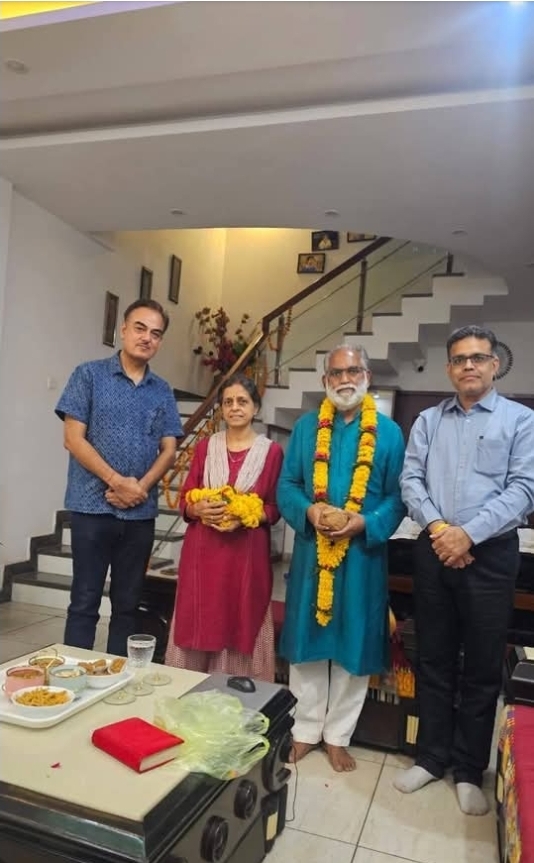
The meeting also reflected Srivastava's long-standing engagement with literature and Indian philosophical thought. During the interaction, he presented Dr Khemariya with a copy of his book Shabdmanas, a remarkable work that interprets every word of the Ramcharitmanas. Srivastava also shared his wish that copies of the book should find a place in the Ram Lalla Temple at Ayodhya, making the work accessible to devotees and readers interested in the epic's deeper meaning.
For those familiar with Srivastava's career, this literary pursuit is a natural extension of interests he nurtured even while serving in government. Yet those close to him believe the Narmada Parikrama has given those interests a deeper sense of purpose. Conversations that once revolved around governance and administration now naturally flow towards faith, human values and the search for inner balance.
In an age where professional success is often measured by position and authority, Srivastava's journey offers a different perspective. His story suggests that some aspirations cannot be fulfilled through office or achievement alone. They require patience, discipline and the courage to honour a promise made not to society, but to oneself.
For the administrative fraternity, the journey also carries a quiet message. Public service demands difficult decisions, relentless schedules and immense responsibility. Yet the ability to pause, reflect and reconnect with one's inner self may be just as important. As Dr Khemariya's interaction with the former IAS officer revealed, the most enduring achievements are not always recorded in official files. Some are written in the silence of a long walk, in the fulfilment of a lifelong resolve, and in the contentment that follows.
The Narmada Parikrama eventually comes to an end for every pilgrim. For Om Prakash Srivastava, however, those who have met him since believe it marked the beginning of a new chapter, one defined less by the authority of office and more by the wisdom that comes from walking a path chosen by the heart.