Union Education Minister Dharmendra Pradhan's resignation has stirred debate on the role of street protests versus parliamentary procedures in shaping political accountability and democratic responses in India.
Dr Ajay Khemariya
The resignation of Union Education Minister Dharmendra Pradhan has triggered mixed political reactions. While opposition groups and sections of the activist ecosystem have welcomed the development, others view it as a strategic political decision rather than a simple response to public protests. Apart from immediate political debate, however, the episode raises a larger question: how should a democratic government respond when political disagreements increasingly shift from Parliament to the streets?
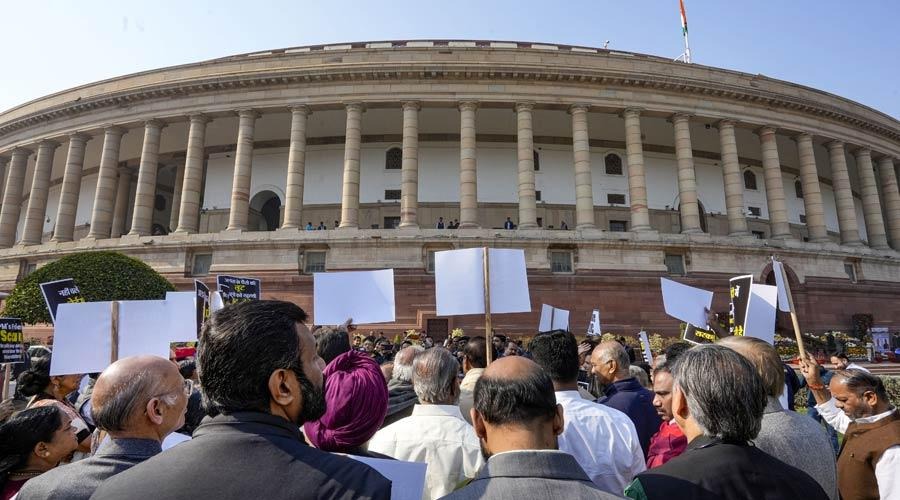
From a parliamentary perspective, the resignation can be seen as an attempt to balance public sentiment with political accountability. Yet the development also comes at a time when sections of the opposition have argued that political change in India will be shaped more through street mobilisation than through electoral politics. Such assertions, require serious reflection because they touch the very character of India's parliamentary democracy.
The central concern is not the resignation itself but the growing tendency to legitimise political pressure through sustained street campaigns. Democratic protest remains a constitutional right, but when organised movements seek to replace parliamentary debate with continuous confrontation, governments face the difficult task of maintaining both democratic openness and public order.
The former Prime Minister Atal Bihari Vajpayee had remarked that when an opponent changes the nature of the contest, political strategy must also adapt. Viewed from that perspective, the resignation is interpreted as a tactical decision intended to prevent a larger political confrontation while allowing the government to recalibrate its response.
At the same time, the government cannot afford to underestimate what appears to be organised ideological campaigns aimed at shaping public opinion through sustained narratives. Reported inputs from the Intelligence Bureau and other sources increasingly point to political mobilisation that extends well beyond conventional electoral politics, relying on information campaigns, digital platforms and coordinated public messaging.
One of the important lessons from the recent controversy is that education has become a major arena of political contestation. Universities and academic institutions are no longer viewed merely as centres of learning but also as spaces where competing ideological narratives seek influence. Successive governments, therefore, need to recognise that educational policy now carries significant political and social implications alongside its academic objectives.
The controversy surrounding the National Eligibility-cum-Entrance Test (NEET) and the pressure faced by the former Education Minister reflected a broader political strategy rather than being directed solely at one individual. The institutional mechanisms responsible for examinations and higher education also need to share accountability, instead of allowing political responsibility to rest entirely on the minister of the day.
The resignation, should therefore serve as an opportunity for the government to reassess not only administrative systems but also its political communication. Maintaining regular dialogue with supporters, academics, students and civil society, is essential to prevent misinformation from gaining ground.
A second challenge, concerns the spread of "manufactured narratives" through digital platforms. Issues ranging from educational reforms to social policy are increasingly debated in an information environment where verified facts often compete with selective interpretations, edited content and viral campaigns. The government, needs to respond more effectively in this space instead of reacting only after public opinion has hardened.
The larger concern, however, is that street mobilisation should not become a substitute for constitutional institutions. Parliament remains the primary forum for political accountability because it derives its legitimacy from the democratic mandate of the people. Public demonstrations have an important place in a democracy, but they cannot replace legislative debate or constitutional mechanisms for political change.
The government's decision to accept the resignation may have helped defuse an immediate political confrontation. Yet it also leaves behind larger questions. How should democratic governments respond to organised political mobilisation? How can public institutions safeguard both the right to dissent and the stability of constitutional governance? And how should governments engage with a rapidly evolving digital information ecosystem where narratives often travel faster than facts?
The answers to these questions will shape more than the political fallout of one minister's resignation. They will influence the evolving relationship between electoral politics, public protest and democratic institutions in contemporary India. The strength of parliamentary democracy ultimately rests not only on electoral mandates but also on the ability of constitutional institutions to remain the principal forum for political accountability, while governments continue to engage with citizens, address legitimate concerns and respond effectively to emerging political and social challenges.