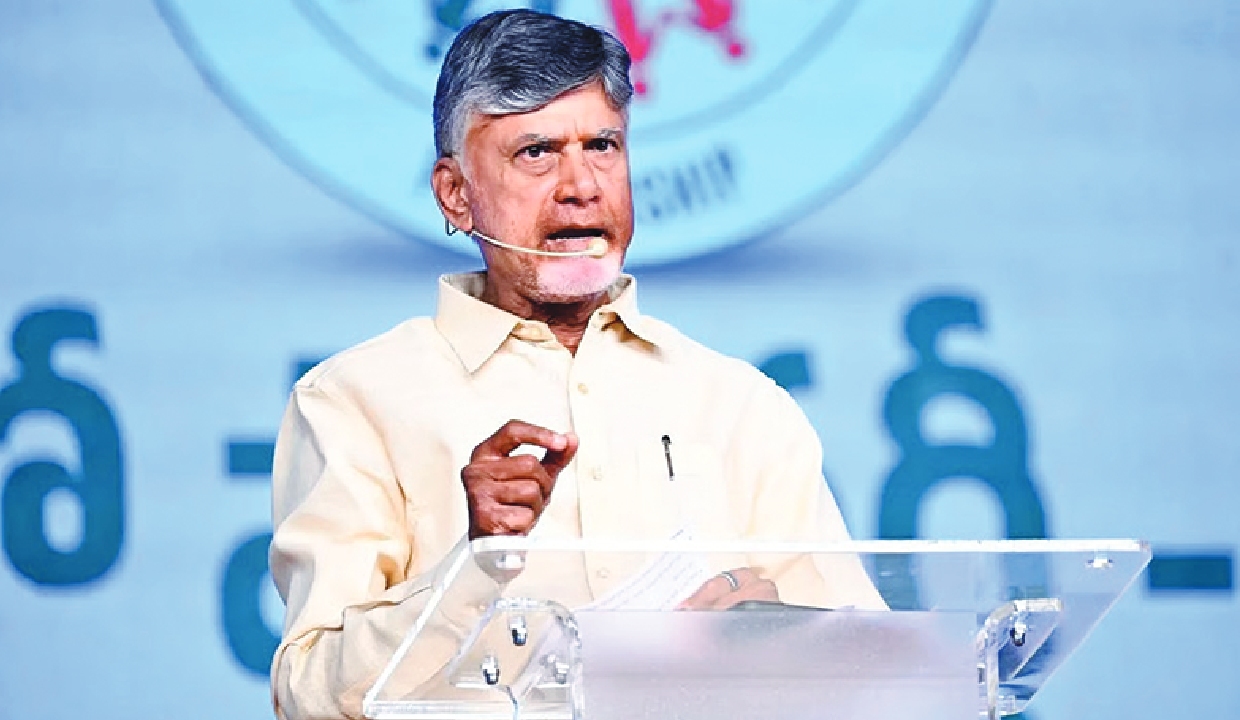
Andhra Pradesh CM N. Chandrababu Naidu proposes incentives for larger families to ensure a balanced workforce, sparking national debate on India's future demographic strategy.
Bhopal. In a country of more than 140 crore people aspiring to become a “Viksit Bharat” by 2047, Andhra Pradesh Chief Minister N. Chandrababu Naidu has triggered a fresh national debate on the future of India’s population policy. His recent appeal asking families to move beyond the long-followed “Hum Do Hamare Do” model has sharply divided opinion across political and economic circles. Naidu announced that the Andhra Pradesh government would provide ₹30,000 for the birth of a third child and ₹40,000 for a fourth child under a proposed “Population Management Policy.” The announcement quickly gained traction on social media and reopened larger questions linked to India’s long-term development vision under Prime Minister Narendra Modi’s Viksit Bharat roadmap.
Supporters of the move described it as a forward-looking attempt to secure India’s future workforce at a time when many developed nations are struggling with ageing populations, shrinking labour pools and slowing economic productivity. Critics, however, called it political messaging in a country still battling unemployment, inflation, pressure on public resources and uneven human development indicators. The Andhra Pradesh government appears to be positioning the proposal as a calibrated demographic strategy rather than unrestricted population expansion. The broader idea is to maintain a balanced and productive workforce for the future economy. Policymakers increasingly believe that India’s demographic strength may become one of its biggest strategic advantages in the race toward becoming a developed nation.
According to academician and author Prof Dinesh Kumar Singh (Political Science), population has always occupied a central place in debates around development, governance and national power in India. For decades, the slogan “Hum Do, Hamare Do” shaped the country’s family planning approach. The idea was simple — smaller families would help improve health, education and economic stability. But India’s demographic debate is now entering a new phase. Prof Singh believes the discussion is important because population is not merely about numbers. It is also about human strength, workforce capacity and long-term economic sustainability. He points out that several developed nations are already facing demographic decline, resulting in labour shortages, ageing populations and rising welfare burdens. According to him, India’s biggest advantage today remains its young demographic profile. A large and productive youth population can strengthen labour supply, industrial growth, consumption and economic expansion. Economists often describe this advantage as India’s “demographic dividend.” At the same time, Prof Singh cautions that population growth without parallel investment in education, healthcare, nutrition, women’s empowerment and employment generation can create long-term social and economic stress. Therefore, the real debate is not simply about increasing population, but about improving the quality of population. He argues that India may ultimately require a balanced demographic strategy — one that avoids both uncontrolled expansion and severe population decline. For Viksit Bharat, the priority should not merely be “more people,” but healthier, educated, skilled and productive citizens capable of contributing meaningfully to national growth. In that sense, India’s future demographic policy may gradually shift from population control to population management rooted in human development.
But behind the politics lies a deeper demographic concern.; Naidu has repeatedly argued that India may face a shortage of productive young workers after two decades if birth rates continue to fall. Andhra Pradesh’s fertility rate has reportedly fallen close to 1.5, much below the replacement level of 2.1 needed to maintain stable population growth. The concern is not entirely unfounded. Countries like Japan, South Korea, Italy, and even China are already battling ageing populations and shrinking workforces. Many economists warn that fewer young workers eventually put pressure on pensions, healthcare systems, and economic growth. However, India’s situation is far more layered. India still remains the world’s most populous nation. Large sections of urban middle-class youth, especially Gen Z couples, are increasingly choosing smaller families. Rising education costs, career pressure, urban lifestyles, delayed marriages, and financial insecurity are changing social behaviour rapidly. Ironically, population growth today is often higher among economically weaker sections where awareness, education, and access to family planning remain limited. This has opened another sensitive debate. Critics argue that financial incentives alone may not automatically create a skilled demographic dividend. Without parallel investments in education, healthcare, nutrition and employment generation, a larger population could also increase economic pressure. That is why Naidu’s “population push” is being seen as a political googly with multiple layers.
Supporters, however, believe India must think ahead before fertility rates decline sharply like many developed nations. They argue that if guided carefully, India’s demographic strength can become a major pillar of the Viksit Bharat vision. The debate has now moved beyond mere numbers and is increasingly centred on building a healthy, skilled and productive population capable of supporting long-term national growth. Whether such policy experiments strengthen India’s human capital advantage will remain to be seen.