India has set up a committee chaired by former Supreme Court Justice to study and address demographic changes due to immigration and other factors.
New Delhi/ Bhopal May 27, 2026
The Centre has constituted a high-level committee to address the challeges of demographic change caused by infiltration and other reasons. In a social media post, Union Home Minister Amit Shah on Tuesday informed that the committee will be chaired by former Supreme Court Judge Justice Prakash Prabhakar Navlekar. Census Commissioner, along with former IAS officer Durga Shankar Mishra, former IPS officer Balaji Srivastava and economist Dr. Shamika Ravi have been appointed as members of the committee. The Joint Secretary (Foreigners-I) in Home Ministry will serve as the Member Secretary in the committee.
Prime Minister Narendra Modi in his Independence Day speech from Red Fort last year had announced about the High-Level Committee on Demographic Change. Shah said that infiltration and other reasons are causing unnatural demographic change which poses a very significant challenge to the present and future of any nation. He said demographic Change is a serious issue linked not only to sovereignty but also to national security, law and order, profound changes in social structure and the preservation of tribal society. The Home Minister said, the committee will conduct a comprehensive assessment of demographic changes occurring across India due to illegal immigration and other unnatural causes. It will also analyze patterns of abnormal population shifts at the levels of religious and social communities and present a planned and time-bound solution for the same.
The Committee will analyse the patterns of abnormal population changes at the level of religious and social communities and will present a well-planned and time-bound solution to address the issue. The Committee will submit its report within one year, if necessary, the tenure of the Committee may be extended by up to six months
The development comes at a time when demographic debates are increasingly influencing political and policy discussions across the world. Many countries are struggling with migration pressures, ageing populations, shrinking native communities and rising identity-related tensions. In India, these concerns have become particularly sensitive in parts of the North-East and several border states, where demographic changes over the past decade have triggered intense social and political debate. Similar demographic pattern shifts have also been noticed in some other regions of the country, adding to wider discussions over migration, population balance, resource pressure and cultural identity.
Several organisations and local groups in the North-East have repeatedly expressed concern over illegal infiltration and changing population patterns. In some areas, community leaders claim the minority population has steadily increased while the Hindu population share has witnessed a relative decline over the years. Supporters of the Centre’s move argue that demographic stability is closely linked to national planning, internal security and long-term social balance. They believe unchecked illegal settlement can place pressure on land, employment, welfare resources and local cultural identity, especially in ecologically and strategically sensitive regions like the North-East.
For now, the Modi government appears determined to place demographic management alongside national security, border protection and development planning as part of its larger long-term governance vision.
India’s Changing Population Landscape: Hindu and Muslim Demographic Estimates at a Glance
India’s demographic story after Independence reflects both the trauma of Partition and the gradual social changes that followed over decades. When the country was divided in 1947, millions crossed borders amid violence and uncertainty. There was no official Census in 1947, but estimates based on the 1941 and 1951 Census suggest that India’s population stood around 34 to 35 crore. Hindus formed the overwhelming majority, estimated at nearly 84 per cent, while Muslims accounted for around 9 to 10 per cent of the population after Partition.
The first official Census after Independence was conducted in 1951. It recorded India’s population at 36.1 crore. Over the next two decades, rapid population growth became a major policy concern for the government. By the 1971 Census, India’s population had crossed 54 crore. Census-linked data later cited by the Union government showed Hindus at nearly 82 per cent and Muslims around 11 per cent. Two decades later, the 1991 Census reflected another major demographic rise. India’s population touched nearly 84 crore. Hindus accounted for around 81.5 percent, while Muslims formed about 12.6 per cent of the population. Demographers say these shifts were shaped by fertility trends, healthcare access, migration, urbanisation and socio-economic development over time.
India does not yet have an official religion-wise Census after 2011 because the 2021 Census was delayed. So, current figures are based on projections by demographers, government estimates and research institutions. According to the 2011 Census, Hindus formed 79.8 per cent of India’s population, while Muslims accounted for 14.2 per cent. Based on population growth trends and projections available till 2024-25,
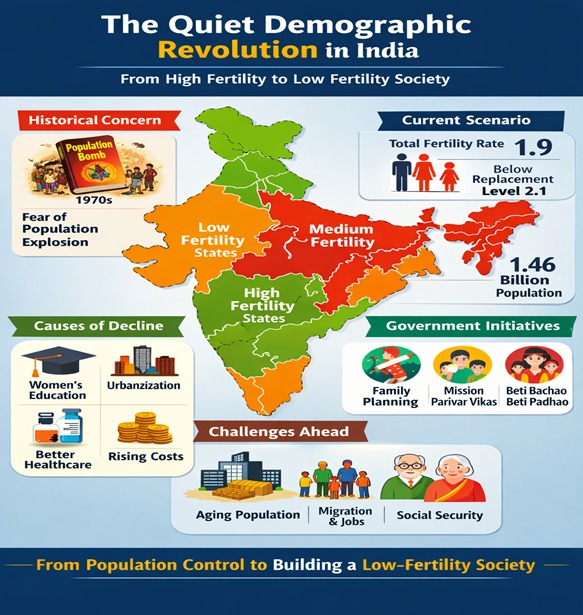
India’s total population is now estimated at around 143 to 145 crore. Experts estimate that the Hindu population is currently between 112 and 115 crore, while the Muslim population is estimated between 20 and 22 crore. This still keeps Hindus as an overwhelming majority at around 78 to 79 per cent, while Muslims are estimated at nearly 15 per cent of the population. Demographers say the gap between communities remains very large in absolute numbers, even though Muslim population growth rates have historically been slightly higher. However, recent National Family Health Survey (NFHS) data also shows fertility rates declining across all communities, including Muslims. Experts believe education, urbanisation, women’s empowerment and economic conditions are gradually reducing demographic differences over time.