Kunti, a central figure in the Mahabharata, carried a profound secret that shaped the epic's narrative. Her life's choices, marked by sacrifice and silent strength, continue to inspire.
Bhopal July 9, 2026
Some people are remembered for what they achieved. Others are remembered for what they silently carried throughout their lives. Kunti belonged to the second kind. Before she became the queen of Hastinapura and the mother of the Pandavas, she was a young princess named Pritha. Her life was filled with responsibilities much earlier than most people realise. The choices she made in her youth remained with her until her final days.
Pritha was born to King Shurasena of the Yadava dynasty. As a child, she was adopted by his cousin King Kuntibhoja, who had no children of his own. From that day, she came to be known as Kunti. She grew up in the royal palace, where she earned a reputation for humility, discipline and hospitality. Those qualities would soon be tested.
One day, the fiery sage Durvasa arrived at King Kuntibhoja's palace as a guest. Known for his unpredictable temper, the sage was served personally by the young Kunti. She attended to him with patience and sincerity throughout his stay. Pleased with her devotion, Sage Durvasa blessed her with a sacred mantra. He told her that by reciting it, she could invoke any deity and receive a child blessed with that god's qualities.
Kunti was still very young. According to the Mahabharata, curiosity led her to test the mantra. She invoked Surya, the Sun God. To her astonishment, Surya appeared before her. The deity assured Kunti that no dishonour would come to her. Yet, through the divine blessing, she gave birth to a son born with natural armour and earrings, symbols of extraordinary destiny.
The child was Karna. For Kunti, joy quickly turned into fear. She was unmarried. Society would not understand what had happened. The burden of honour weighed heavily on the young princess. With a heart full of pain, she placed the infant in a basket and set him afloat on a river, praying that destiny would protect him. The baby was found and lovingly raised by Adhiratha, a charioteer, and his wife Radha.
Years later, the world would know him as one of the greatest warriors of the Mahabharata. Kunti, however, carried that memory in silence. Time moved on.
Kunti married King Pandu of Hastinapura. Their married life began with hope, but fate intervened once again. After Pandu was cursed by Sage Kindama, he renounced the throne and retired to the forest with Kunti and his second wife, Madri.
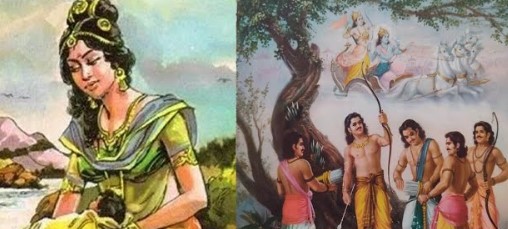
The curse meant Pandu could never father children. It was then that Kunti revealed the secret of Sage Durvasa's mantra to her husband. With Pandu's consent, she invoked Dharma, and Yudhishthira was born. She then invoked Vayu, giving birth to Bhima. Finally, she invoked Indra, and Arjuna was born. Later, at Kunti's suggestion, Madri used the same mantra to invoke the Ashwini Kumaras, giving birth to the twins Nakula and Sahadeva.
Together, the five sons came to be known as the Pandavas. After Pandu's death and Madri's self-immolation, Kunti returned to Hastinapura as a widow with five young children. Her life changed once again. She was no longer only a queen. She became a mother whose every decision was guided by the future of her sons. She stood beside them through palace conspiracies, exile, humiliation and uncertainty. Whether they lived in a royal palace or in the forests, Kunti remained their source of courage.
Yet one truth never left her. Karna was alive. She watched from a distance as he grew into a mighty warrior and eventually became Duryodhana's closest friend. She recognised him as her firstborn, but the time to reveal the truth had long passed. On the eve of the Kurukshetra War, Kunti finally met Karna in private. She told him the truth about his birth.
It was one of the most emotional conversations in the Mahabharata. Karna listened quietly.
He refused to abandon Duryodhana, who had stood by him when the world questioned his birth. Yet he made one promise to his mother. Except for Arjuna, he would not kill any of the Pandavas. It was a promise born out of both duty and sorrow. After the war, Kunti revealed Karna's true identity to her sons. The revelation left the Pandavas grief-stricken. They realised they had fought and lost their own elder brother without knowing the truth.
In her later years, Kunti renounced royal life. Along with Dhritarashtra and Gandhari, she retired to the forest. According to the Mahabharata, all three eventually perished in a forest fire, bringing to an end lives marked by sacrifice, suffering and unwavering duty.
Kunti's story is not merely the story of the Pandavas' mother. It is the story of a woman who faced impossible choices with remarkable strength. She carried a secret that no one else could bear. She accepted loss without surrendering to despair. She raised leaders while carrying her own sorrow in silence.
Perhaps that is why Kunti continues to inspire readers even today. The Mahabharata reminds us through her life that courage is not always found on the battlefield. Sometimes, it is found in a mother's quiet resolve to keep moving forward, even when her heart carries wounds that the world can never see.
Series Note: This article is based primarily on the Mahabharata and follows widely accepted traditional translations. Where later traditions differ in interpretation, the narrative remains anchored in the epic's principal account.