The Madhya Pradesh Assembly passed the Uniform Civil Code Bill, which will regulate marriage, divorce, and inheritance. It awaits Presidential assent to become law.
Bhopal July 21, 2026
The Madhya Pradesh Assembly on Tuesday passed the Madhya Pradesh Uniform Civil Code (UCC) Bill, 2026, bringing the state a step closer to implementing a common civil law governing matters such as marriage, divorce, inheritance, adoption and live-in relationships. The Bill will now be sent to the President for assent. It will come into force only after receiving Presidential approval.
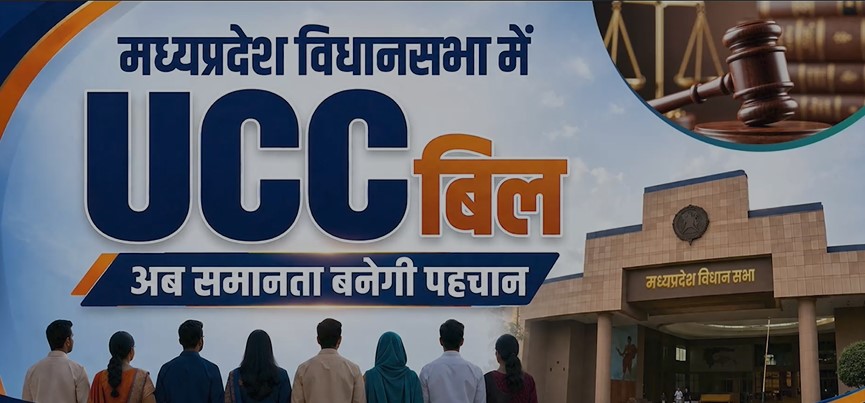
With the passage of the Bill, Madhya Pradesh is poised to join the growing list of states moving towards a Uniform Civil Code, a reform that the state government says is aimed at ensuring equality before law, gender justice and uniform civil rights across communities.
Speaking after the Bill was passed, Chief Minister Dr Mohan Yadav said the legislation would strengthen constitutional values by ensuring equal rights and responsibilities for all citizens. He described the Bill as a significant step towards social justice and women's empowerment, adding that the government was committed to implementing reforms that promote equality and public welfare.
The proposed law seeks to establish a common legal framework for civil matters irrespective of religion. It provides for uniform provisions relating to marriage, divorce, succession, inheritance and adoption. The Chief Minister said that once the law comes into force, practices such as triple talaq, halala and polygamy would not be legally recognised under the state's civil code. He also said women would enjoy equal inheritance rights alongside men.
The Bill also proposes to regulate live-in relationships. According to the government, violations of prescribed legal provisions relating to such relationships, including misuse or non-compliance with statutory requirements, could attract penal action. The Chief Minister said the objective was to prevent exploitation while safeguarding the rights and dignity of women.
Describing the legislation as an important step towards women's empowerment, Dr Yadav said equal legal rights in matters of succession, adoption and family relations would provide greater protection to women. He said the government viewed the legislation as a reform intended to strengthen social harmony and constitutional equality.
The Chief Minister also linked the legislation to the vision of Prime Minister Narendra Modi and Union Home Minister Amit Shah, stating that the Bill reflected the party's commitment to equality, social justice and public welfare. He congratulated the Assembly for passing the legislation and said Madhya Pradesh had taken a significant legislative step in implementing a long-debated constitutional objective.
The Bill was passed by voice vote after discussion in the Assembly. During the debate, the Chief Minister criticised the Congress over its stand on the Uniform Civil Code and argued that India should move towards a common civil law applicable to all citizens. Those remarks formed part of the political debate surrounding the legislation.
The Uniform Civil Code derives its constitutional basis from Article 44 of the Directive Principles of State Policy, which states that the State shall endeavour to secure a uniform civil code for citizens throughout the territory of India. While the Directive Principles are not enforceable in courts, they serve as guiding principles for governance and legislative policy.
The Bill is now set to be sent to the President for assent, a constitutional requirement before it can be notified and brought into force in Madhya Pradesh. Once it receives Presidential approval, the state government will frame the necessary rules and notify the date of implementation. The legislation is expected to usher in a uniform civil framework governing marriage, divorce, inheritance, adoption and other civil matters across the state.