Prince Devavrata forgoes his claim to the throne, pledging lifelong celibacy to fulfill his father's wish, profoundly impacting the Kuru dynasty and earning the name Bhishma.
Bhopal, July 3, 2026
Every family has expectations. Some children inherit wealth. Some inherit responsibilities. Very few inherit a burden so great that it changes the course of history. Prince Devavrata was one such son. Long before the Mahabharata reached the battlefield of Kurukshetra, he made a decision that altered the destiny of the Kuru dynasty forever.
Devavrata was the only son of King Shantanu and Goddess Ganga. After years of education under great sages, Ganga returned the young prince to his father. He had mastered the Vedas, warfare, statecraft and the principles of dharma. Shantanu proudly declared him the heir to the throne of Hastinapura. The kingdom saw in Devavrata everything a future king should be—wisdom, courage, discipline and compassion.
For a time, peace returned to the royal family. But destiny was preparing another test. Some years later, King Shantanu met Satyavati, the daughter of a fisherman. He wished to marry her. Satyavati's father respected the king but placed a condition before him. Only the son born to Satyavati should inherit the throne of Hastinapura.
The condition left Shantanu heartbroken. He could not deny the rights of Devavrata, who had already been declared crown prince. At the same time, he could not forget Satyavati. The king returned to the palace without revealing the reason for his sorrow. Yet his silence did not escape the notice of his son.
Concerned for his father, Devavrata learnt the truth from the royal ministers. Without informing Shantanu, he rode to the fisherman's settlement. There, he announced that he was giving up his claim to the throne. The fisherman was moved by the prince's sacrifice. Even so, he feared that Devavrata's future children might one day seek the kingdom and challenge Satyavati's descendants.
It was then that Devavrata made the vow that has echoed through history. He pledged that he would never marry. He would never have children. He would remain a lifelong celibate so that no one born from him could ever claim the throne of Hastinapura. According to the Mahabharata, the vow was so extraordinary that the gods showered flowers from the heavens. Witnessing the terrible nature of his promise, they gave him a new name—Bhishma, meaning the one who had taken a fearsome vow.
When King Shantanu heard what his son had done, he was overwhelmed with both pride and sorrow. He blessed Bhishma with the boon of iccha mrityu, the ability to choose the time of his own death. It was a rare blessing, but it also reflected the king's recognition that no ordinary reward could match the sacrifice his son had made.
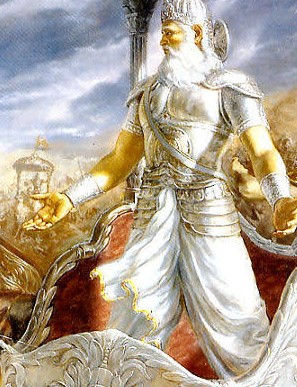
Bhishma remained true to his promise throughout his life. He never sought the throne he had renounced. Instead, he devoted himself to protecting the Kuru kingdom and guiding successive generations of its rulers. He served Chitrangada, Vichitravirya, Dhritarashtra, Pandu and later the Kauravas and the Pandavas with the same unwavering sense of duty.
Yet the greatness of Bhishma lies not only in what he gave up but also in the questions his life leaves behind. His sacrifice fulfilled his father's wish, but it did not end the kingdom's troubles. The succession crisis returned after the deaths of Chitrangada and Vichitravirya. It was this crisis that eventually brought Ved Vyasa back to Hastinapura to preserve the Kuru lineage. In time, the descendants born from that line would become the Kauravas and the Pandavas.
The Mahabharata does not tell us whether Bhishma's decision was right or wrong. Instead, it invites readers to reflect on a deeper question. Can even the noblest sacrifice carry unforeseen consequences? Bhishma chose duty over personal happiness. He never regretted that choice. But the kingdom he gave up never found lasting peace.
Perhaps that is why Bhishma remains one of the most respected figures in the epic. He was not honoured because he was invincible in battle. He was honoured because he placed duty above himself, even when the cost was his own future.
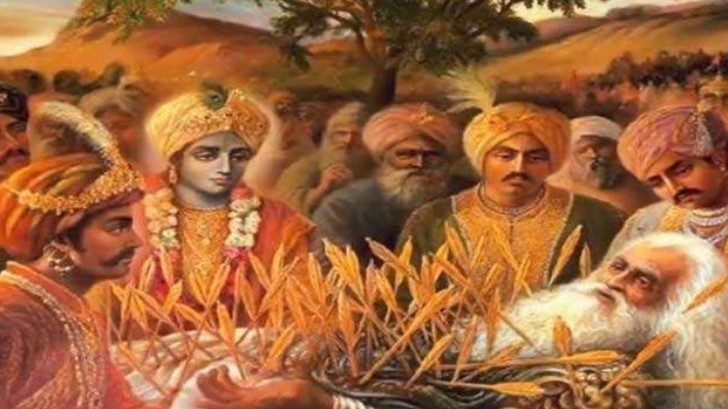
Bhishma's story reminds us that true sacrifice is rarely made in moments of glory. It is made quietly, without certainty of reward, and often without knowing how history will judge it. Devavrata gave up a throne so that his father could find happiness. In doing so, he became Bhishma. But he also became the silent guardian of a dynasty whose fate he could guide, though never control.
Series Note: This article is based primarily on the Mahabharata (Adi Parva) and follows the narrative found in widely accepted traditional translations. Reflective observations are intended to help modern readers understand the human dimensions of the epic and are not presented as direct statements from the text.