Kuno National Park's success in reintroducing cheetahs in India hinges on the relentless work of veterinarians, trackers, and forest staff, facing extreme conditions and complex challenges daily.
Sheopur/ Bhopal July 13, 2026
Visitors to Kuno National Park often hope for a glimpse of a cheetah sprinting across the grasslands. Few realise that behind every such sighting lies an extraordinary human effort unfolding quietly every day. The success of India's ambitious cheetah reintroduction programme depends not only on the animals adapting to a new home but also on an army of veterinarians, forest officers, trackers and frontline staff who work around the clock, often far away from public attention.
The latest newsletter released by Kuno National Park offers a rare glimpse into this unseen world. It describes what may be one of the most demanding wildlife management operations anywhere in the world. At present, 49 cheetahs are being managed in and around Kuno, of which 30 wear satellite collars requiring continuous monitoring. Twenty of them roam freely across landscapes spread over 12 districts in Madhya Pradesh and Rajasthan, while the remaining cheetahs live in large, semi-wild enclosures designed to closely resemble their natural habitat.
Unlike many wildlife conservation programmes that rely largely on periodic surveys, Kuno's field teams monitor individual cheetahs every day. Radio signals are tracked through forests, riverbeds, rocky hills and agricultural landscapes. Summer temperatures frequently cross 45 degrees Celsius, while the monsoon transforms dry streams into swollen rivers. Yet the daily monitoring never stops. Teams spend long hours in vehicles or trek for kilometres on foot simply to ensure that every animal is accounted for.
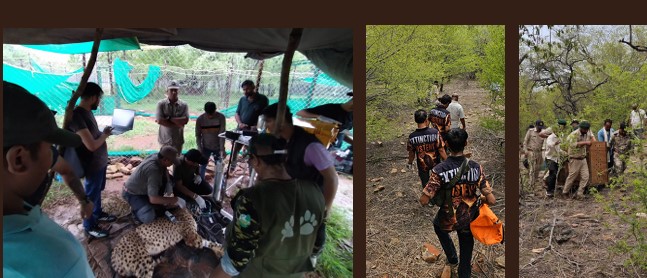
The challenge extends far beyond tracking. Wildlife veterinarians are responsible for health care, rescue operations, immobilisation and the special management of mothers and cubs. Rescue missions often require travelling hundreds of kilometres across two states, sometimes through the night. During heavy rain, field teams shield immobilised animals from getting wet while simultaneously managing oxygen cylinders, intravenous drips and monitoring equipment. These are operations that rarely make headlines but demand precision, teamwork and immense patience.
The newsletter also underlines another reality often overlooked in public discussions. Bringing back a species declared extinct in India is not simply about releasing animals into the wild. Every cheetah must gradually adapt to India's climate, prey base, vegetation, parasites, competing predators and landscapes where wildlife and people live in close proximity. At the same time, the managers themselves continue learning through every new situation, making Project Cheetah as much a journey of adaptive management as ecological restoration.
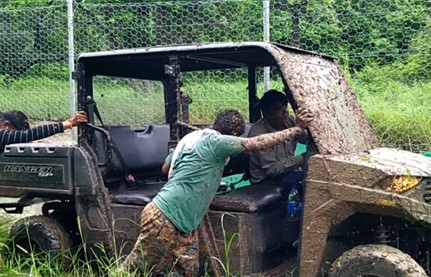
Perhaps the most striking message emerging from Kuno is that conservation is built on teamwork rather than hierarchy. The newsletter notes that there is no separate "field unit". Some officers plan operations, others arrange logistics, veterinarians provide medical care, trackers follow radio signals and frontline staff ensure every piece of equipment is in place. But once an operation begins, everyone walks together, travels together, solves problems together and shares responsibility for the outcome.
Behind the day-to-day operations is a multidisciplinary conservation team led by Principal Chief Conservator of Forests (Wildlife) Dr Sameeta Rajora, with Field Director Uttam Kumar Sharma and Divisional Forest Officer Thirukural R. coordinating one of the country's most intensive wildlife management programmes. Supported by veterinarians, trackers, rescue teams and frontline forest personnel, the team has built a system where science, field experience and constant monitoring work together to support the successful return of the cheetah to Indian forests.
The return of the cheetah to India has naturally drawn global attention. Yet the real story is not only about the fastest land animal reclaiming a place in Indian forests. It is equally about the quiet professionalism of the people who spend countless nights in the wilderness, often without recognition, to ensure that the world's first intercontinental translocation of wild cheetahs has a genuine chance to succeed. If India's conservation success is measured in the years ahead, Kuno's greatest legacy may well be the dedication of the anonymous teams who have turned an ambitious vision into a living reality.