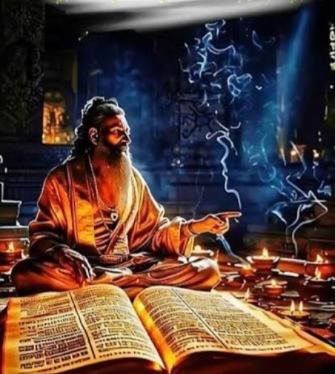
Ved Vyasa, known for composing the Mahabharata, played a pivotal role in preserving the Kuru dynasty by fathering heirs through the practice of niyoga, ensuring the continuation of a lineage critical to the epic's narrative.
Bhopal July 4, 2026
Sometimes, history remembers a person for the book he wrote. But there are moments when his greatest contribution lies elsewhere. Ved Vyasa was one such man. Long before he composed the Mahabharata, he returned to Hastinapura to save a royal family that stood on the brink of extinction.
His story began long before the birth of the Pandavas and the Kauravas. Vyasa was born to Sage Parashara and Satyavati on a small island in the Yamuna. Because of his dark complexion, he was called Krishna. Since he was born on an island, he came to be known as Dvaipayana. Together, the two names became Krishna Dvaipayana.
Soon after his birth, Vyasa chose the life of a sage. He left his mother and devoted himself to meditation, learning and spiritual discipline. Over time, he became one of the greatest scholars of his age. Ancient tradition credits him with organising the vast body of Vedic knowledge into four parts. Because he classified the Vedas, he came to be known as Ved Vyasa. He was respected not only as a sage but also as a teacher whose knowledge shaped generations.
Years passed. Meanwhile, events in Hastinapura took an unexpected turn. King Shantanu had married Satyavati. Their sons, Chitrangada and Vichitravirya, were expected to carry forward the Kuru dynasty. But fate had other plans. Chitrangada died in battle without leaving an heir. Vichitravirya also died at a young age without children. Suddenly, the mighty Kuru dynasty faced a succession crisis.
For Queen Satyavati, it was a painful moment. She remembered the son she had given birth to years earlier. She sent word to Ved Vyasa and requested him to return to Hastinapura. Vyasa came, not as a prince seeking power, but as a sage responding to his mother's call.
According to the Mahabharata, an accepted social custom of that period, known as niyoga, allowed a worthy man to father children on behalf of a deceased king to preserve the royal lineage. The practice was recognised under specific circumstances and reflected the social traditions of that era. Accepting this responsibility, Ved Vyasa fathered three sons through the widowed queens and a maidservant attached to the royal household.
The eldest was Dhritarashtra, born to Queen Ambika. He was born blind.
The second was Pandu, born to Queen Ambalika. He later became the king of Hastinapura. The third was Vidura, born to a maidservant. Though he never became king, he grew into one of the wisest and most respected voices in the Mahabharata. With their birth, the Kuru dynasty survived.
Years later, Dhritarashtra became the father of the Kauravas. Pandu became the father of the Pandavas. Their rivalry eventually led to the great war of Kurukshetra. It is one of history's remarkable ironies.
Without Ved Vyasa's return to Hastinapura, there may have been no Dhritarashtra, no Pandu, no Kauravas and no Pandavas. The story that later became the Mahabharata might never have unfolded in the way the world knows it today. Yet Vyasa never sought the throne. He never ruled the kingdom. His role was that of a guide, a teacher and, whenever needed, a guardian of the Kuru family.
Later in life, tradition credits him with composing the Mahabharata, preserving not only the story of a royal family but also timeless reflections on duty, justice, sacrifice and human nature. Through the dialogue between Krishna and Arjuna in the Bhagavad Gita, the epic became one of the world's greatest works of philosophy.
Ved Vyasa's life reminds us that true greatness does not always lie in holding power. Sometimes it lies in accepting responsibility when others step away. He answered his mother's call without seeking reward. In doing so, he preserved a dynasty and, unknowingly, gave future generations one of humanity's greatest epics.
Series Note: This article is based primarily on the Mahabharata (Adi Parva) and follows widely accepted traditional translations. The reference to niyoga is presented in its historical and cultural context as described in the epic. Reflective observations are intended to help modern readers understand the human dimensions of the narrative and are not presented as direct statements from the text.