Cinema holds supreme power in the Indian consciousness. Thus, it is no surprise that actors often transcend their on-screen characters to become equal to a ‘hero’. This transcendence from an actor to a character to a hero is the most intriguing intersection where a fan’s desire to emulate and become them becomes sharp. And for an Indian, there can’t be a grander event than a wedding to fulfil these fantasies. Perhaps that’s the reason why most Indian weddings have become more of a performance than an actual ritual.
Rashmika Mandanna and Vijay Deverakonda’s wedding has set the internet on fire. From their regal outfits by Manish Malhotra and Torani to their over-the-top gold jewellery ensembles, fans across the nation are obsessed with their looks. While there is no harm in a little fan movement dissecting and immersing itself in their wedding pictures, what often goes unnoticed is the market behind these stars.
Immediately after the couple’s wedding pictures took the internet by storm, the makers of ‘Ranabaali,’ the new film starring Rashmika Mandanna and Vijay Deverakonda, released its teaser. Posting on Instagram, Rashmika Mandanna commented that the special video featuring the two in their new ‘avatar’ from Ranabaali is the best wedding surprise. However, one cannot miss the timing of the release, seemingly designed to garner attention for their upcoming joint venture.
Manyavar, too, hopped onto the internet frenzy surrounding the couple by releasing its new advertisement featuring the duo in the lead. Manyavar, an Indian ethnic wear brand, couldn’t have possibly attracted more attention this wedding season than with the timely launch of its new couple brand ambassadors.
These releases may appear organic and like the ‘right move at the right time’. But are they really as organic and natural as they look? For a celebrity to come to an agreement with a brand, complete a shoot, and set a release date requires at least six months. For audiences to believe that all the stars aligned perfectly during their ‘holy matrimony’ is nothing but a façade. One only needs to notice the timing of celebrity weddings and their brand collaborations.
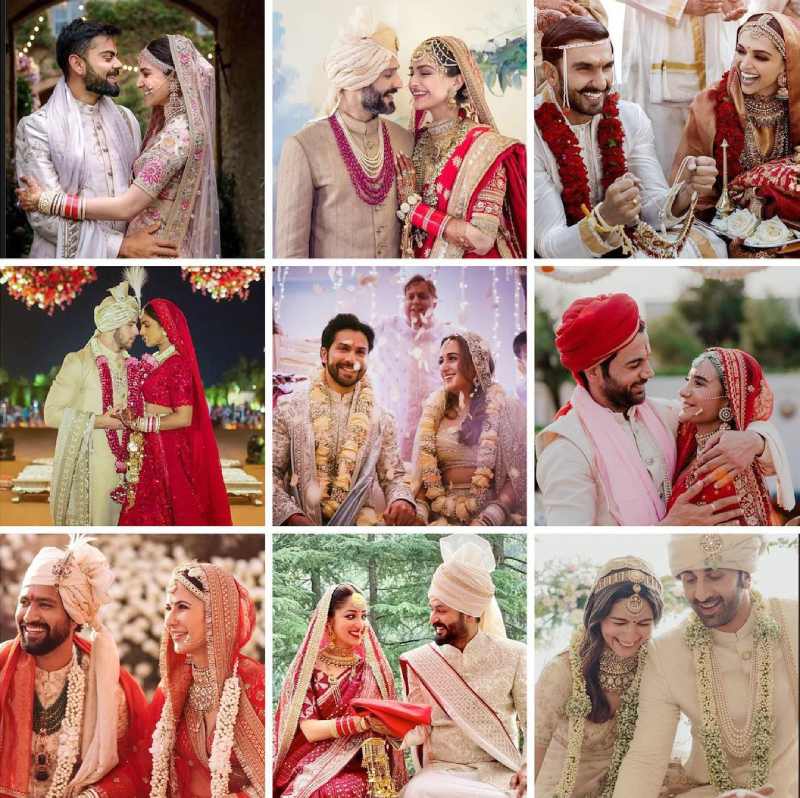
Anushka Sharma and Virat Kohli became the much-celebrated faces of Manyavar Mohey through anticipation shortly after their marriage. Their wedding outfits by Sabyasachi Mukherjee became a staple designer reference in weddings that followed. Priyanka Chopra and Nick Jonas released their exclusive wedding video with People Magazine. The international icon flaunted her Bvlgari mangalsutra in a post-marriage picture, a brand she represents as an ambassador. The conversation around Priyanka Chopra becoming the only second Ralph Lauren bride wasn’t just about friendship between the two talents but also about opening doors to the Indian market. Deepika Padukone and Ranveer Singh released their wedding video five years later in collaboration with Disney+ Hotstar and Koffee With Karan.
In the business world, Radhika Merchant and Anant Ambani’s wedding lasted for more than six months, certainly not just to celebrate the union of two families, but to build the union of many business deals across the world. Many critics of the ‘circus’ called the wedding celebration a coronation of the next king of the Reliance Industries empire.
There is absolutely nothing wrong with making the right commercial choices for both celebrities and brands. That is, after all, part of their job description. But the domino effect it creates in upper-middle-class and middle-class families is certainly concerning.
The upsurge in the ‘eventisation’ of marriage, the trend of becoming a ‘social media commodity’ through Instagram couple pages, and the sheer vulgar display of wealth in the name of weddings are disturbing. From buying outfits worth lakhs to appease the desire to look like a hero, to shooting embarrassing pre-wedding videos, to hiring every possible extravagance just to have a ‘day in the life of a star’, the spectacle demands some reflection. Weddings today are no longer about rituals. They are productions. The bride and groom are performers, the guests are spectators, and the stage is set not for meaning, but for money.
This performative culture is deeply shaped by pop culture. Just as Karwa Chauth has become a pan-Indian ritual through the influence of Karan Johar’s cinema, the modern wedding has evolved into a Bollywood-inspired spectacle. Celebrity weddings, wrapped in designer couture and exclusive venues, are less celebrations of love and more vehicles to sell aspiration. Each lehenga, location, and hashtag fuels a massive consumer ecosystem of event planners, stylists, and luxury vendors, all capitalising on the illusion of exclusivity.
Ironically, in trying to be “different,” everyone ends up looking and acting the same. One can perform a content analysis of all the wedding pages floating on social media today to see that the content of each reel, the design of each dress, and the shot of each video are identical. This is Antonio Gramsci’s cultural hegemony in action. The dominant class normalises its values, aesthetics, and lifestyles so effectively that they begin to appear desirable to everyone else. It’s not your dream. It’s the one sold to you.
So the real question remains: when did we stop getting married and start performing weddings? In a country still grappling with poverty and inequality, perhaps the bigger reflection is not about how grand a wedding can be, but about what a wedding should truly mean.
(The writer is a PhD scholar at Centre for Media Studies, Jawaharlal Nehru University and a film critic.)